Asian shares experienced significant gains on Tuesday, buoyed by steady performance in U.S. stock markets as investors remained attentive to developments regarding the ongoing conflict in the Middle East. U.S. futures saw a modest uptick alongside oil prices, reflecting a cautious optimism among traders.
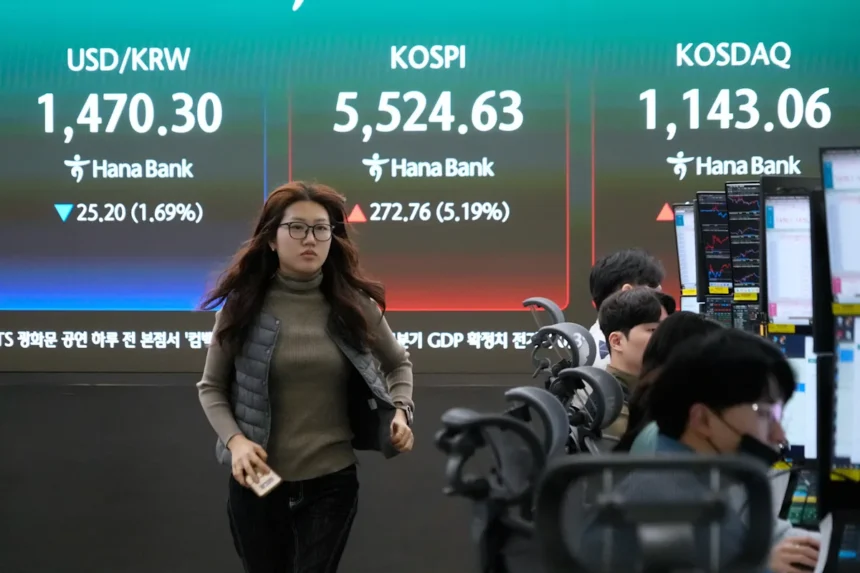
In Japan, the Nikkei 225 index surged 2.1%, closing at 55,387.75, while South Korea’s Kospi saw a robust increase of 3.5%, reaching 5,724.30. Investors in Hong Kong also enjoyed positive returns, with the Hang Seng index rising 0.3% to 26,039.23, while the Shanghai Composite index gained a slight 0.1%, ending the day at 4,127.34. Australia’s S&P/ASX 200 rose 0.5% to $8,738.50, and Taiwan’s benchmark index climbed significantly by 3.9%.
On the U.S. front, the S&P 500 experienced a slight dip of 0.2%, closing at 6,781.48, following a day of volatile trading driven by wild fluctuations in the oil market. The Dow Jones Industrial Average decreased by 34 points, or 0.1%, settling at 47,706.51, while the Nasdaq composite advanced marginally, rising less than 0.1% to 22,697.10.
Oil prices, initially hitting dramatic highs, have shown signs of decline after reaching nearly $120 per barrel earlier in the week, marking the highest price since 2022. As of early Wednesday, Brent crude, the international benchmark, saw an increase of 9 cents, priced at $85.36, which is still down 11% from the previous day’s settlement. U.S. benchmark crude oil rose by 36 cents, settling at $83.81 per barrel.
The fluctuating oil prices are primarily attributed to concerns over supply disruptions caused by the conflict in the region. After President Donald Trump indicated in an interview that he believes the war may soon be concluded, market participants reacted positively, fostering hopes for a resumption of oil flows from the Middle East. However, rising tensions have fueled stark rhetoric from both sides, as the conflict enters its 11th day.
U.S. Defense Secretary Pete Hegseth has warned of escalating military responses, detailing that the U.S. has successfully targeted numerous Iranian vessels engaged in mining activities. In retaliation, Iranian authorities have vowed to obstruct oil exports from the region, asserting that they will not permit “even a single liter” to be shipped to adversarial nations.
Trump, in a social media post, reiterated the strategic importance of the Strait of Hormuz, a critical chokepoint through which a significant portion of global oil passes daily. He emphasized that any action by Iran to impede the flow of oil in this area would provoke a severe response from the U.S.
Despite the market’s historical resilience during military conflicts, concerns linger about the durability of high oil prices and the potential for ongoing volatility. The current geopolitical uncertainties have driven remarkable intra-day market swings, leaving investors on edge as they navigate this complex and evolving situation.