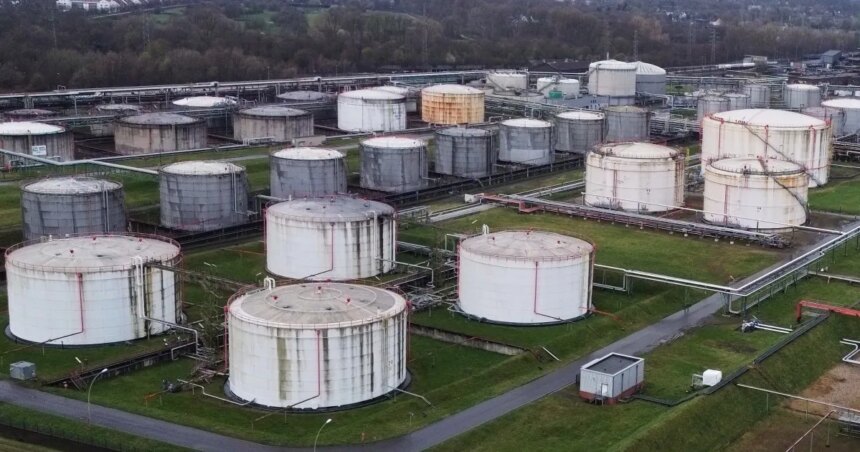
Global oil prices continue to escalate, defying expectations following an unprecedented announcement from the International Energy Agency (IEA) regarding the largest release of emergency reserves in history. Brent crude, the key international benchmark, surged approximately 15 percent after the IEA declared it would release 400 million barrels to help stabilize the tumultuous market in the aftermath of escalating conflict between the United States, Israel, and Iran.
As of Thursday morning, oil prices hovered around $100 a barrel—marking a staggering increase of over 35 percent since the onset of hostilities. However, analysts caution that while the IEA’s release may provide short-lived relief, its impact on lowering prices will be marginal if the Strait of Hormuz, a critical maritime route for oil transport, remains effectively closed.
“It’s not a silver bullet to solve everything. You have to solve the underlying problem,” noted Maksim Sonin, an energy executive affiliated with Stanford University’s Center for Fuels of the Future, highlighting the market’s focus on persistent concerns. The Strait of Hormuz, bordering Iran, Oman, and the United Arab Emirates, is crucial for global oil supply, with about 20 million barrels traditionally passing through daily. However, recent threats from Iran’s Islamic Revolutionary Guard Corps (IRGC) to block all oil shipments have resulted in a near halt of traffic through this vital channel, which has led to serious disruptions.
Reports surfaced indicating that at least five commercial vessels had been attacked in the region, including two oil tankers in Iraq’s al-Faw port. In a mix of optimism and uncertainty, U.S. President Donald Trump has made varying statements regarding the duration of the conflict, indicating that resolution could come quickly or that U.S. forces still have work to do.
The volatility of oil prices over the past week reinforces the fragility of the market. Brent crude prices fluctuated sharply, hitting a high of $119 before dropping below $80 in a matter of days, following incorrect assertions regarding U.S. Navy operations in the Strait.
Despite the historical significance of the IEA’s release of strategic reserves, which aims to address an acute and growing shortfall, experts warn it will only provide temporary relief. The ongoing conflict has already created a shortfall exceeding 200 million barrels, significantly larger than the IEA’s planned release.
“The release will only buy temporary relief,” cautioned Gregor Semieniuk, a professor at the University of Massachusetts Amherst, resonating with fears that market expectations may have already priced in the IEA’s efforts. Semieniuk suggests that once the reserves are drawn down, the continued disruption could amplify the market’s concerns about sustained supply shortages.
Furthermore, there are logistical challenges regarding how quickly the IEA member countries, which collectively manage reserves totaling around 1.8 billion barrels, can translate these stockpiles into market-ready oil. Although the U.S. plans to release 172 million barrels starting next week and Japan is set to begin its release of 80 million barrels, these volumes may not suffice to offset the ongoing supply crisis.
Market experts express that if traders are convinced that supply will meet demand in the near term, prices might stabilize temporarily. However, uncertainty lingers; if disruptions continue and doubts about the sufficiency of replacement supplies arise, historical precedents suggest a sharp rebound in prices could occur.
In previous IEA coordinated releases, the outcomes have varied. Following an announcement of 60 million barrels in response to Russia’s invasion of Ukraine in 2022, oil prices surged, while earlier releases during the 1991 Gulf War helped stabilize the market.
Looking ahead, should the closure of the Strait of Hormuz persist, analysts predict a possible rise in prices to unprecedented levels. Semieniuk projected that if tight supply conditions continue, oil might soon exceed $150 a barrel, with some calculations hinting that significant supply cuts could potentially lead to prices soaring above $200. The situation remains fluid, with traders bracing for further developments as the geopolitical climate continues to shape global oil dynamics.