On February 28, 2026, the United States and Israel initiated military strikes against Iran, resulting in significant casualties. Reports indicate that the conflict has claimed the lives of over 1,000 Iranian civilians, while in Israel, at least 11 individuals—and three in the United Arab Emirates—have died as a result of Iranian counterattacks, which included the loss of six U.S. service members.
In the backdrop of crisis, the financial markets continue their turbulent path, leaving investors grappling with difficult decisions. Historical parallels are being drawn to similar geopolitical events, particularly the Gulf War in the early 1990s, as stakeholders attempt to navigate the uncertain landscape.
Following the military actions, global oil prices surged by more than 30 percent, rapidly escalating the cost of this critical resource. This increase had already begun prior to the strikes, with oil trading approximately 60 percent higher than its 2026 low. The surge can be largely attributed to the growing apprehension surrounding potential disruptions in the Strait of Hormuz, a vital artery for the transportation of oil, where approximately one-fifth of the world’s oil supply passes through.
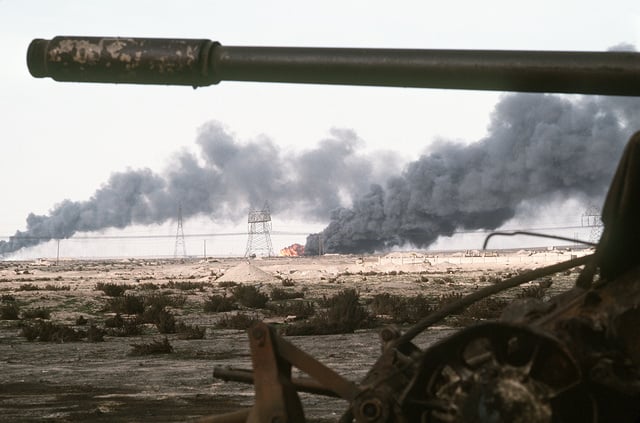
Historically, when Iraq invaded Kuwait in 1990, the U.S. descended into Operation Desert Shield and later Operation Desert Storm to liberate Kuwait. The stock market’s response during that period was dictated not necessarily by the ongoing battles but by the implications for oil prices, inflation, confidence, and the potential for recession. Market analysts noted that the economy was already weakening before Iraq’s invasion, which exacerbated the impact of rising oil prices.
In 1990, the U.S. was grappling with high interest rates and a fragile economy. The unemployment rate was already on the rise, peaking at 5.9 percent just after the invasion. Rising oil prices during this time created substantial headwinds for consumers and businesses, and the aftermath was a recession often characterized by a misalignment between economic indicators and the stock market’s reactions.
Fast forward to 2026, the current economic climate mirrors certain aspects of that earlier period, yet without the definitive contraction observed in 1990. Discussions surrounding the oil market now revolve around not only immediate reactions but also longer-term implications as the U.S. economy contends with slowing growth, a noticeable uptick in unemployment, and an inflation rate above the Federal Reserve’s target.
As the price of Brent crude could potentially reach and fluctuate between significant figures, analysts outline various potential paths for both the economy and stock market. If oil prices peak significantly but then taper off, there’s a chance of managing the aftermath without entering a recession, whereas sustained high prices could pose severe risks to corporate margins and consumer spending, thereby increasing the chances of an economic downturn.
Market reactions historically indicate that stock prices do not merely react to the realities of war—rather, they respond intricately to the ensuing economic consequences, primarily the impact on oil prices. The events surrounding the Gulf War suggest that after an initial drop in the markets with the surge in oil prices, a recovery is possible once clarity emerges about the oil supply situation and inflation expectations stabilize.
In light of these considerations, analysts encourage investors to remain vigilant about oil prices, inflation, and broader economic signals as the situation develops. The responses from businesses, households, and policymakers will be critical in determining the trajectory of markets moving forward. Analysts anticipate varying degrees of market corrections but remain cautiously optimistic about recovery in the medium term, contingent on developments in the oil market and overall economic resilience.
While the current situation in 2026 may evoke similarities to the geopolitical tensions of the past, the paths ahead remain uniquely shaped by the interplay of evolving circumstances, making it imperative for investors to keep a close watch on both economic indicators and global events.