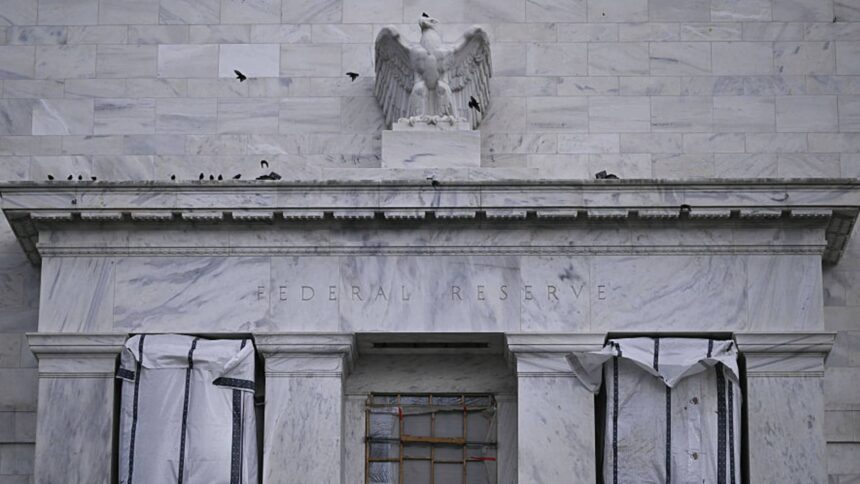
Construction work at the Marriner S. Eccles Federal Reserve building in Washington, D.C., continues as economic analysts navigate the complexities of the current inflation landscape. A recent report from the Bureau of Labor Statistics revealed a surprising spike in wholesale inflation for February, prompting traders to reconsider their expectations for interest rate cuts from the Federal Reserve this year.
The producer price index (PPI) recorded its most significant gain in a year, suggesting that inflationary pressures are persisting and potentially intensifying. This unexpected increase has prompted futures markets to eliminate realistic prospects for a rate decrease until at least December 2025. Even at that point, the likelihood of a reduction during the final Federal Open Market Committee (FOMC) meeting of the year has diminished, now estimated at around 60%. Factors contributing to this sustained inflation include ongoing tariffs, the ongoing conflict in Iran, and rising costs in the services sector, which are collectively complicating the Fed’s monetary policy decisions.
As the FOMC prepares to announce its latest interest rate decision, experts suggest that the PPI report may reinforce a status quo decision, while simultaneously hinting at a more hawkish outlook. Eugenio Aleman, chief economist at Raymond James, noted that even if rates remain unchanged, a shift toward a “higher for longer” strategy could be on the horizon, particularly with energy inflation expected to become a more pressing concern in the coming months.
Prior to the onset of the conflict in Iran on February 28, market expectations had leaned towards potential rate cuts in both June and September, with a possibility of another cut in December. However, these projections have significantly deteriorated post-report. Odds for a June cut have fallen to approximately 18.4%, while July sits at 31.5% and September at 43.6%, according to calculations by the CME’s FedWatch tool, which utilizes 30-day fed funds futures contracts to predict market movements.
Despite the late-year expectations of a potential cut sitting at 60.5%, this figure reflects a relatively low level of conviction among traders. Historically, such a threshold has been more tightly correlated with actual Fed decisions. Currently, futures data indicates an anticipated fed funds rate of 3.43% by the end of 2026, down from the existing rate of 3.64%.
Uncertainty remains in the market, with volatility inherent in trading fed funds futures. Some Federal Reserve governors, including Stephen Miran and Christopher Waller, are lobbying for immediate rate cuts. However, the prevailing sentiment within the committee leans toward maintaining current rates until there is greater clarity in the economic framework.
As policymakers grapple with the evolving economic indicators, the stakes rise, making the upcoming FOMC meeting a pivotal moment in determining the trajectory of U.S. monetary policy amidst ongoing inflation challenges.