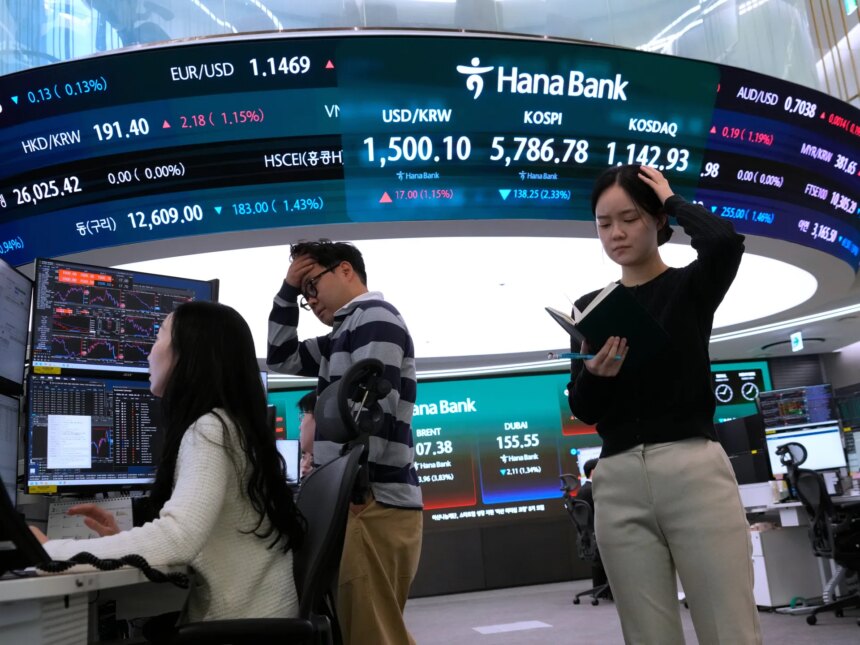
Asian stock markets experienced a significant downturn as recent attacks on natural gas facilities in Qatar, Iran, and the United Arab Emirates heightened concerns about global energy supplies. Early Thursday trading saw Japan’s benchmark Nikkei 225 and South Korea’s KOSPI both fall nearly 3 percent, reflecting increasing unease in markets already affected by the effective closure of the Strait of Hormuz and the ongoing restriction of oil and gas exports from the Gulf region.
In response to these developments, futures for Brent crude, the global oil benchmark, surged over 4 percent, surpassing $112 a barrel and marking its highest price in more than a week. With Japan and South Korea relying heavily on imported fossil fuels—meeting about 80 to 90 percent of their energy needs through imports—these tensions are particularly alarming. In 2024, these nations ranked as the second and third largest importers of liquefied natural gas (LNG), bringing in 68 million tonnes and 47 million tonnes, respectively. Qatar was a significant supplier, contributing 77.2 million tonnes and standing as the world’s third-largest LNG exporter, trailing only the United States and Australia.
The downturn in Asian markets followed notable declines in US stocks the previous day, driven by rising inflation fears in the world’s largest economy. The S&P 500 index fell approximately 1.4 percent, while the tech-heavy Nasdaq Composite experienced a nearly 1.5 percent drop.
Experts have characterized the attacks on energy facilities as a “major escalation” in the regional conflict. Jason Feer, global head of business intelligence at Poten & Partners, indicated that while the attacks have disrupted traffic through the strategically vital Strait of Hormuz, the physical damage to energy installations had been relatively light, up to that point. However, any significant damage to oil and gas production facilities could lead to prolonged supply disruptions, even if hostilities were to cease.
Qatar reported on Wednesday that its principal LNG export facility at Ras Laffan Industrial City, the largest of its kind globally, sustained “significant damage” from Iranian missile strikes. QatarEnergy, the state-run energy company, confirmed that other LNG facilities had also been attacked, resulting in sizable fires and extensive damage.
In a statement on social media, US President Donald Trump issued a warning to Iran, threatening severe consequences for any further attacks on Qatar’s energy infrastructure. He hinted at “massively blow[ing] up the entirety” of the South Pars gas field if Tehran persisted in its aggression.
In the UAE, operations at the Habshan gas facility and the Bab oilfield were suspended due to dangers posed by falling debris after successful interceptions of Iranian missile strikes. Saudi Arabia also disclosed that it had countered an attempted drone strike aimed at a gas facility in its eastern region, as well as missile attacks targeting the capital, Riyadh.
The recent Iranian assaults follow a pledge from Tehran to retaliate against Israeli strikes on its South Pars gas field, which is the largest in the world. The ongoing attacks on critical energy infrastructure throughout the Middle East have intensified pressure on energy prices, exacerbated by a near collapse of maritime traffic across the Strait of Hormuz, where only a few vessels, primarily flagged by India, Pakistan, and China, have been able to pass since the conflict escalated 20 days ago.
Consequently, oil prices have surged more than 50 percent since the outbreak of hostilities, which began with US-Israeli airstrikes on Iran on February 28. The situation continues to evolve, with market participants closely monitoring developments as they assess the implications for global energy security.