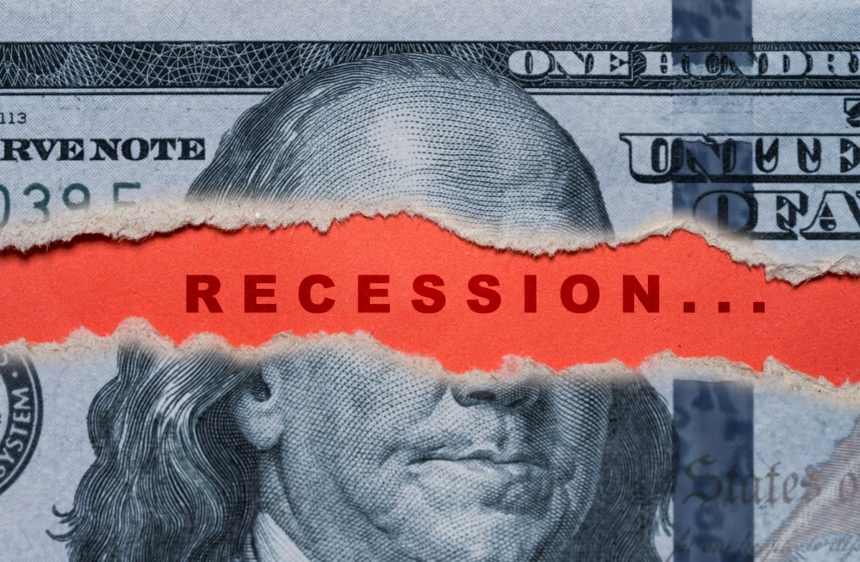
In recent trading sessions, the S&P 500 index has experienced a notable decline, falling 3% from its 2026 high amid rising concerns about elevated market valuations and economic challenges resulting from President Trump’s tariffs. The past year saw the U.S. economy grappling with its slowest growth in gross domestic product and job creation since the onset of the pandemic, as businesses adapted to a continuously shifting trade landscape.
More alarmingly, investors are now focusing on escalating geopolitical tensions in the Middle East, particularly the ongoing U.S.-Iran conflict, which has contributed to a surge in Brent crude oil prices—recently surpassing $100 per barrel for the first time since 2022. According to Mark Zandi, chief economist at Moody’s, these developments could potentially lead the U.S. economy into recession.
Concerns about market valuations were underscored during the Federal Reserve’s January meeting, where officials noted that asset valuation pressures were significantly elevated. Minutes from the gathering indicated that price-to-earnings ratios for public equities were at the upper end of their historical range. The S&P 500’s cyclically adjusted price-to-earnings (CAPE) ratio reached an alarming 39.2 in February, marking one of the highest valuations recorded in history. Notably, the index has not achieved such a monthly CAPE multiple above 39 since the dot-com crash in 2000.
The current climate of high valuations is particularly troubling, given that rising oil prices could compound the economic headwinds engendered by the existing tariffs, potentially pushing the S&P 500 into a significant correction or bear market, while simultaneously elevating the risk of a recession.
JPMorgan Chase strategists Kriti Gupta and Joe Seydl recently articulated the potential impact of sustained oil prices, stating that prices around $90 per barrel might trigger a 10% to 15% decline in the S&P 500. They highlighted a concerning domino effect, where each 10% drop in the stock market could result in a 1% reduction in consumer spending, exacerbating the oil shock’s effects on the economy.
Similarly, analysts from Goldman Sachs warned of dire consequences should global oil supply disruptions persist, with predictions suggesting that the S&P 500 could plummet to 5,400 by 2026—a 22% drop from its January peak of 6,979—marking an entry into bear market territory.
In an earlier analysis, Mark Zandi signaled that the rising oil prices could substantially elevate recession risks. Using a machine learning model, he had already estimated a 49% chance of a recession occurring in the next year prior to the conflict with Iran. Historically, instances where the model’s readings surpass 50% have led to subsequent recessions. He indicated that it would not be surprising to see this indicator breach the crucial threshold amid ongoing conflicts and rising crude prices. Zandi cautioned that if oil prices remain high for an extended period, avoiding a recession could become increasingly difficult.
Historically, the S&P 500 has endured significant downturns during recessions, experiencing an average peak-to-trough decline of 32% since its inception in March 1957. The data indicates that past recessions have seen declines ranging from 14% to 57%, suggesting that investors should brace for possible challenging times ahead if Zandi’s predictions about rising oil prices leading to economic downturns materialize.
While these indicators may seem grim for investors, experts advise against liquidating stocks indiscriminately. There remains no guarantee that a recession will indeed occur, and timing the market is notoriously difficult. Instead, investors are encouraged to curate robust portfolios featuring high-conviction stocks they would be comfortable holding through turbulent times. Additionally, building a cash position may prove beneficial, affording investors the opportunity to capitalize on potential buying opportunities should the stock market experience significant declines in the near future.