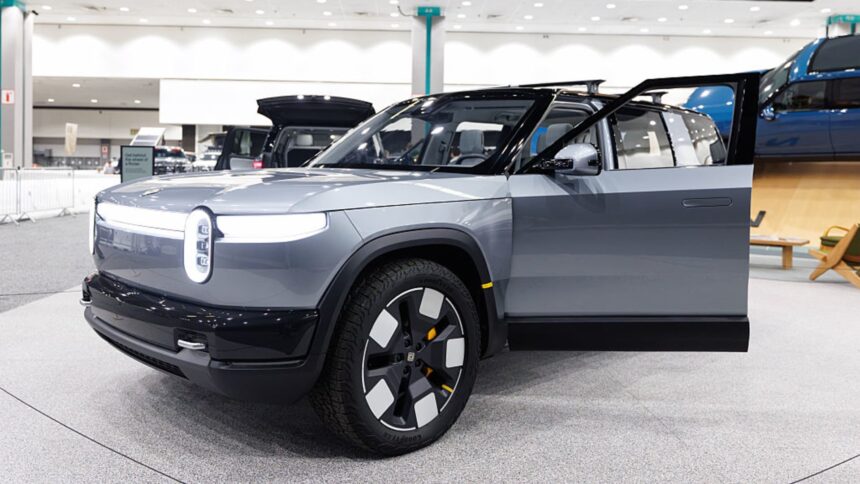
The Rivian R2, the next-generation electric vehicle, has made its debut at the 2025 Los Angeles Auto Show, capturing the attention of industry stakeholders. During the show, Rivian announced a significant partnership with Uber Technologies, which plans to invest as much as $1.25 billion in the electric vehicle manufacturer. This collaboration aims to roll out up to 50,000 robotaxis by the year 2031 across various global markets.
As part of this strategic alliance, Uber is set to acquire 10,000 autonomous variants of Rivian’s R2 vehicle, with an option to expand this purchase by up to 40,000 additional units starting in 2030. Following this announcement, Rivian’s shares experienced a notable rise of approximately 8% to 10% in premarket trading, while Uber’s stock remained relatively stable.
This deal emerges amid a renewed interest in autonomous vehicle technology and robotaxi services, highlighting the industry’s aim to tap into a projected multitrillion-dollar market. Notably, Uber and several other companies have previously struggled to meet their targets in the realm of robotaxi deployment.
An initial investment of $300 million from Uber is expected to flow to Rivian soon, pending regulatory approval. This upfront investment is expected to translate to about 19.55 million shares of Rivian, as confirmed by a company spokesperson. Additional funding tranches are planned, contingent upon meeting specific milestones through to 2031.
Moreover, Uber is anticipated to incur licensing fees associated with its use of Rivian’s proprietary autonomous driving software. Under this collaboration, the R2 robotaxis will be exclusively offered via Uber’s ride-hailing and delivery services in 25 cities across the U.S., Canada, and Europe, starting with San Francisco and Miami in 2028.
Uber’s CEO, Dara Khosrowshahi, expressed his confidence in Rivian’s integrated approach to vehicle design, computing platform development, and software solutions. He emphasized that Rivian’s focus on maintaining control over manufacturing and supply logistics in the U.S. aligns well with Uber’s ambitious targets for their partnership.
This investment marks a continuation of Rivian’s pattern of securing capital, following a substantial $5.8 billion software deal with Volkswagen revealed at the end of 2024. Additionally, Uber’s investment indicates a scaling up of initiatives related to robotaxis, following their recent collaborations with other electric vehicle manufacturers, including Lucid and Amazon’s Zoox.
Rivian’s CEO, RJ Scaringe, has publicly shared the company’s vision for the R2 and its capabilities, particularly in the realm of robotaxis. He noted that emerging technologies, including advancements in artificial intelligence and semiconductor capabilities, serve as promising indicators for successfully deploying autonomous vehicles.
At Rivian’s inaugural Autonomy and AI Day, Scaringe reiterated the potential of the company’s growing data ecosystem, alongside their cutting-edge Rivian Autonomy Processor, to accelerate progress in autonomous driving technology in the near future.