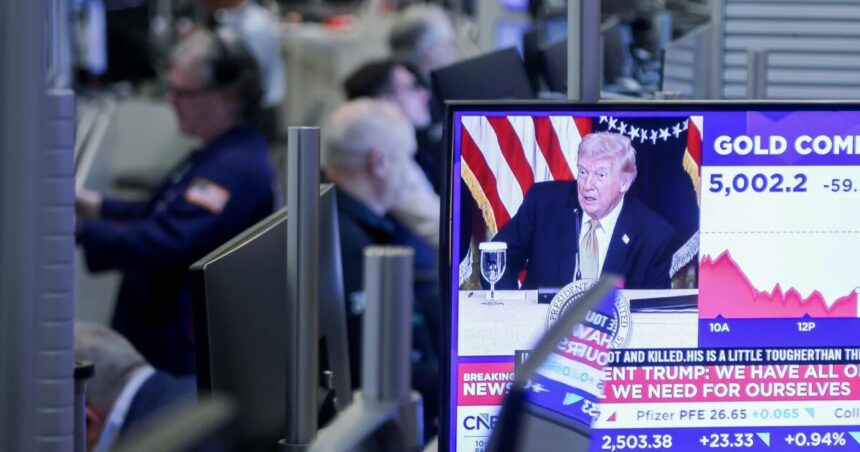
U.S. equities are experiencing significant volatility as Wall Street navigates the ongoing conflict in Iran, now entering its third week. Despite initial anxieties tied to the turmoil, market sentiment appears to be stabilizing, with signs that investors are becoming more optimistic.
Concerns remain, particularly regarding surging oil prices influenced by the shutdown of the Strait of Hormuz. This disruption threatens to exacerbate inflation, which could diminish the likelihood of an interest-rate cut from the Federal Reserve and heightens the risk of an economic slowdown or recession. The escalating situation is also putting supply chains for various products—including metals, materials, food, and pharmaceuticals—at risk. On top of these geopolitical issues, lingering apprehensions about artificial intelligence disruption and exposure to private credit continue to weigh on market sentiment.
In the face of these challenges, many investment professionals seem to be adapting to the geopolitical landscape. The S&P 500 Index rose by 1.3% this week, marking its best two-day performance since the beginning of the U.S. and Israel’s military actions. Currently, the index is down only 3.8% from its all-time high recorded in January. Market indicators suggest that options traders are unwinding some of their bearish positions, and a recent drop in equity exposure could signal that the market is finding a stable level.
Sam Stovall, chief investment strategist at CFRA, noted that the current losses are below the threshold typically associated with a market pullback. “I think, in many ways, investors are encouraged by the resilience of the market,” he stated, highlighting that this might reflect an anticipated improvement in earnings growth estimates.
Protective options against a 5% decline in the State Street SPDR S&P 500 ETF, known as SPY, have become cheaper compared to earlier this month when they reached their highest levels in over a year. Additionally, the Cboe Volatility Index (VIX), which hit highs of 35 earlier, has shown signs of calming, closing around 22. This decline in VIX indicates a decreased sense of panic among investors, as evidenced by reduced demand for options betting on a VIX spike and outflows from long VIX exchange-traded products, according to Barclays’ derivatives strategists.
Despite ongoing volatility, the declines in the S&P 500 have been considered “comparatively modest.” Noah Weisberger, chief strategist at BCA Research, noted the time it takes to reach a 5% pullback could be an encouraging sign; the index took more than 47 days to achieve such a decline. Historically, the S&P 500 has not entered a bear market when taking over 40 days to decline 5%.
Experts also observe that heightened geopolitical uncertainty isn’t new to Wall Street, with the current conflict merely shifting the focus. Sameer Samana, head of global equities and real assets at Wells Fargo Investment Institute, emphasized that rapid selloffs are typically short-lived unless there’s a major threat to the global economy, suggesting that diversifying investments may be wiser than fleeing from emerging conflicts.
Looking ahead, market analysts ponder what may trigger a return to record highs for the S&P 500. Stovall suggested that even the prospect of negotiations could serve as a catalyst. “If we do find that there are at least negotiations taking place… I think that would be a trigger,” he asserted.
Samana pointed to the reopening of the Strait of Hormuz as a crucial factor. A swift resolution could stabilize the market, but prolonged uncertainty could lead to higher oil prices, pressing the S&P 500 toward critical support levels. “If the Strait closure drags on for months, then the possibility of much higher oil prices could lead the S&P to break key support,” he warned, highlighting the potential risk of retail investors capitulating under such pressure.