In a significant effort to attract international business leaders, China hosted a gathering in Beijing that brought together over 70 chief executives, including prominent figures like Tim Cook of Apple, Sergio Ermotti of UBS, and Georges Elhedery of HSBC. The forum, part of the annual China Development Forum, aimed to position China as a bastion of stability and reliability amid global uncertainties, notably referencing a tumultuous geopolitical landscape in the United States.
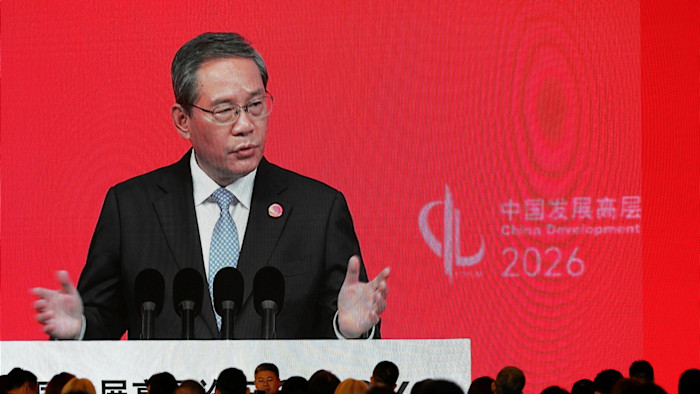
Premier Li Qiang addressed the attendees at the Diaoyutai State Guesthouse, emphasizing that China’s robust supply chain and predictable commercial environment make it an attractive destination for foreign investment. He described the country as a “cornerstone of certainty” and a “harbor of stability,” especially in light of rising trade protectionism and shifts within the international trading system. Li stated, “China will unswervingly promote high-level opening up to the outside,” pledging to import quality goods and collaborate with various partners to enhance global trade.
This year, the focus is on China’s latest five-year economic plan, which outlines a vision for 2030 that seeks to capitalize on foreign investments. Analysts noted that while Li refrained from naming the United States directly, his remarks seemed designed to convey that China offers a safer and more stable business environment compared to its counterpart, particularly in an era of increasing conflict and geopolitical strife.
The conference occurs at a time when China’s trade surplus has reached a staggering $1.2 trillion, prompting concerns in Europe about the impact of inexpensive Chinese imports on local job markets. The economic plan reiterates China’s commitment to a manufacturing-oriented, high-tech industrial strategy, which some believe may further threaten Western production.
In support of this economic strategy, Pan Gongsheng, governor of the People’s Bank of China, defended the nation’s export practices, attributing competitiveness to economic reforms, the vast domestic market, and strong supply chains rather than government subsidies. He hinted at broader systemic issues, pointing to persistent trade deficits in certain countries as indicative of an international monetary system overly reliant on a single currency.
Among the executives in attendance were representatives from major corporations, including Siemens, Volkswagen, and Nestlé, with significant representation from U.S. executives making up 45% of invitees. Financial services led the sectors represented, comprising 22% of the participants, while the energy sector was notably underrepresented, at just 4%.
Tim Cook also had the opportunity to address the forum, highlighting potential opportunities in China, especially in education and technology sectors. Unlike previous gatherings, President Xi Jinping did not meet directly with the executives, though speculation persists regarding a potential visit later this year.
Prior to the main event, Vice-Premier He Lifeng hosted a dinner with European executives to discuss the five-year plan, with most participants expressing optimism about business prospects in China. However, the conversation did not shy away from acknowledging concerns about overcapacity and implications for European industries.
Overall, the conference underscored China’s strategic messaging to global business leaders, positioning itself as a reliable partner amid ongoing global economic shifts.