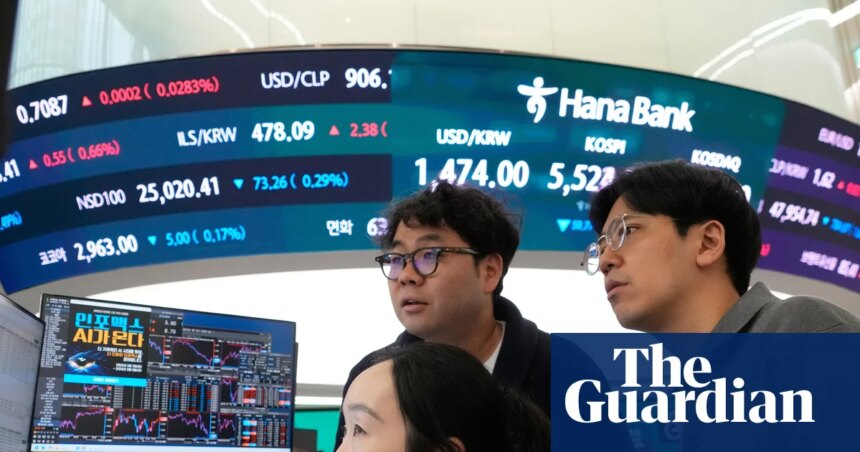
The global oil market is experiencing a notable shift as prices have dipped considerably, coinciding with the rise of Asian stock markets following reports of a new 15-point peace framework sent to Iran by former President Donald Trump. This has sparked optimism regarding a potential ceasefire in the Middle East. On Wednesday, oil prices fell approximately 4% early in the trading session, with Brent crude futures plummeting below the pivotal $100 a barrel mark, even reaching a low of $97.57. This downturn in oil prices is largely attributed to expectations that the cessation of hostilities might alleviate the current pressure on oil supplies.
In tandem with declining oil prices, major stock markets in Asia have shown positive movement. Japan’s Nikkei index surged by 2.9%, while India’s S&P BSE Sensex increased by nearly 2%. Hong Kong’s Hang Seng Index also marked a gain of just under 1%. European markets reflected this upward trend as well, with London’s FTSE 100 up by almost 1%, Germany’s Dax trading 1.8% higher, and France’s Cac 40 witnessing a rise of 1.5%.
However, the relief in oil prices was short-lived as they began to climb again, influenced by mixed signals concerning the negotiations between the US and Iran. Iran refuted claims that discussions had taken place since the commencement of the bombing campaign. The geopolitical tensions have exacerbated the situation, particularly as Iran’s effective closure of the Strait of Hormuz has severely impacted global shipments of oil and gas. The International Energy Agency has described this disruption as the most significant in oil supply history.
In response to these developments, over 30 countries, including the United Arab Emirates, the UK, France, Germany, Canada, and Australia, have jointly reaffirmed their commitment to ensuring the security of this critical shipping waterway.
The volatility in global markets, triggered by the ongoing Middle Eastern conflict, has also affected the gold market, with the precious metal typically viewed as a safe haven during crises. Gold prices have surged in recent months, earlier crossing the $5,000 mark per ounce for the first time ever in January due to increasing geopolitical tensions. However, following the initiation of the US and Israeli bombing campaign, gold has retracted approximately 13%, currently hovering around $4,460 an ounce, raising concerns about its reliability as a financial safety net.
Larry Fink, the CEO of BlackRock, the world’s largest asset management firm, voiced significant concerns regarding the implications of a prolonged Middle Eastern conflict on global oil prices, predicting they could potentially reach $150 a barrel, which he believes could lead to a global recession. Fink articulated two possible scenarios: one where the conflict resolves and Iran is accepted back into the international fold, allowing oil prices to stabilize at pre-war levels, and another where elevated prices persist for an extended period, resulting in profound economic implications and a likely steep recession.