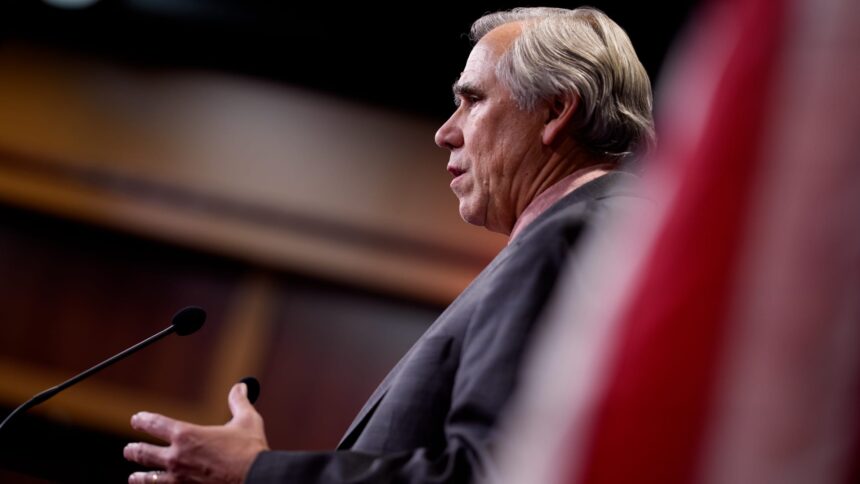
A coalition of congressional Democrats has recently unveiled legislation aimed at banning prediction market bets on various significant issues, including elections, government actions, war, and sports. This initiative, propelled by Senators Jeff Merkley of Oregon and Elizabeth Warren of Massachusetts, along with Representative Jamie Raskin of Maryland, comes in the wake of growing concerns over the implications of these popular betting platforms.
The legislation, known as the STOP Corrupt Bets Act, was introduced following a series of timely bets that spotlighted the potential misuse of prediction markets. Notable instances include wagers tied to the political upheaval in Venezuela and ongoing conflicts in Iran. Senator Merkley voiced strong concerns about the integrity of democratic processes, stating, “When anyone can use prediction markets to make a well-timed bet on Congress passing a bill, government decisions, or a military strike, it’s ripe for corruption and erodes public trust.” He emphasized that the act seeks to preserve the original intent of prediction markets and safeguard democratic institutions from being commodified.
The measure advocates broader restrictions than many existing legislative proposals, reflecting escalating pressures to regulate the rapidly growing prediction market space, which enables users to bet on a wide range of events. Additionally, bipartisan efforts are underway, with Senators Adam Schiff of California and John Curtis of Utah collaborating on legislation to bar contracts specifically tied to sports prediction markets, framing their activities as akin to unregulated gambling.
In reaction to these legislative movements, Kalshi, one of the major prediction market platforms, criticized the Schiff-Curtis proposal, alleging that it primarily serves the interests of casino operators seeking to eliminate competition. The platform contends that such measures prioritize monopolistic protections over consumer welfare.
Meanwhile, a bipartisan group in the House has also proposed a rule prohibiting members of Congress, as well as the President and other executive officials, from engaging in prediction market trading. Earlier in the month, Merkley joined forces with Senator Amy Klobuchar from Minnesota to introduce a complementary proposal aimed at preventing elected officials from profiting through these markets.
As lawmakers intensify their scrutiny, both Kalshi and Polymarket announced new protective measures against insider trading on their platforms. Kalshi, in particular, stated it no longer allows markets related to war or death.
Furthermore, Merkley, Warren, and Raskin’s proposal seeks to clarify the standing of these markets under federal law regulating contract trading, aiming to restore regulatory power to individual states. This comes amidst a surge of at least 20 lawsuits across various states, with gaming regulators asserting that prediction markets exploit a loophole in gambling laws and should thus be subject to state regulation.
The proposed legislation would also mandate a comprehensive study by the Government Accountability Office (GAO) on prediction markets and their association with insider trading, aiming to bring clarity and oversight to an increasingly contentious domain.
Responses from representatives of the prediction markets were not immediately available, leaving the impact of these legislative movements uncertain as the debate continues to unfold.