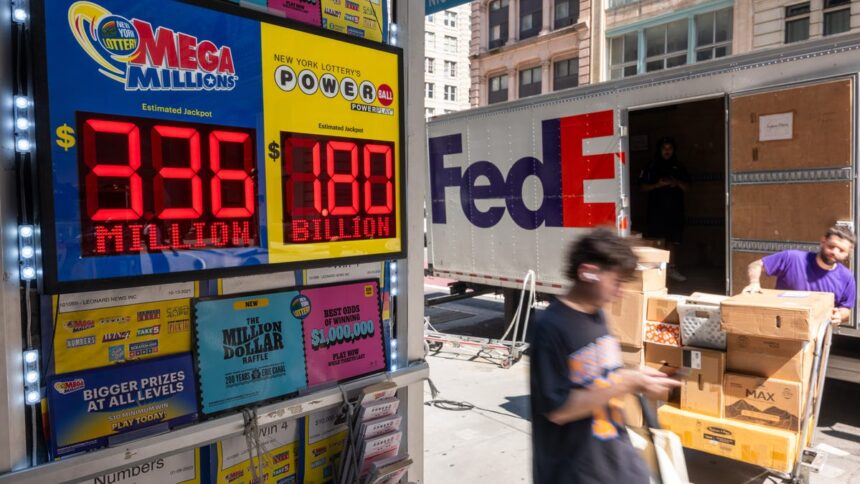
The upcoming Powerball drawing scheduled for Saturday, September 6, at 10:59 p.m. ET offers a staggering jackpot of $1.8 billion, making it a highly anticipated event. With ticket sales approaching a frenzy, players across the country are hoping to strike it rich, despite the extremely low odds of winning—approximately 1 in 292 million. For context, the U.S. Census Bureau reports a population of about 342 million nationwide.
As anticipation builds, individuals in places like New York City are vocalizing their dreams for what they would do with a billion-dollar windfall—envisioning everything from charitable contributions to attending concerts like those of pop star Ariana Grande. Many see purchasing a Powerball ticket as an affordable opportunity to dream big, with a ticket price starting at just $2. Economics professor Victor Matheson points out that although the cost is low relative to the potential winnings, the investment is poor from a rational financial standpoint.
Tickets can be bought at various outlets, including convenience stores and gas stations, across 45 states, Puerto Rico, Washington, D.C., and the U.S. Virgin Islands. In some regions, options to purchase tickets online are also available. To participate, players must select six numbers: five white balls ranging from 1 to 69 and one red Powerball between 1 and 26. Matching all five white balls and the red Powerball in any order qualifies for the jackpot prize. However, if no one wins, the drawing continues until a winning ticket is purchased.
Should a ticket holder emerge as the winner, they have the choice of either an annuity option that pays out the estimated $1.8 billion over 30 years or a lump sum of approximately $826.4 million. Historically, most winners opt for the lump sum payment. Furthermore, significant prizes also exist for those who don’t hit the jackpot—secondary prizes can reach $1 million or more.
Deadlines for buying tickets vary by state, with most closing one to two hours before the drawing. On the East Coast, residents typically have until around 10 p.m. local time, while those on the West Coast may need to buy tickets as early as 6:45 p.m. local time.
Experts caution that the lottery should primarily be viewed as a form of entertainment rather than a viable investment strategy. The allure of the Powerball is accompanied by the potential psychological pitfalls, especially for those who may be struggling financially. Responsible playing is emphasized, and those with gambling issues are encouraged to reach out for support.
Winners are also confronted with hefty tax responsibilities. Federal taxes can consume a significant portion of the winnings, with an automatic withholding of 24% levied on lump sums and potential marginal tax rates climbing up to 37%. Depending on their state and local jurisdictions, winners may face additional taxation.
An average American spends approximately $320 yearly on lottery tickets, a figure that varies dramatically by state. Massachusetts residents lead the way with an expenditure of about $915 per person, while North Dakotans spend the least at a mere $50. In total, Americans allocated approximately $103 billion on lottery tickets in 2023, resulting in $69 billion distributed in prizes.
While dreams of winning the jackpot can be exhilarating, past winners often reveal that life-altering prizes come with unique challenges. Some have experienced significant life changes, including strained relationships and financial turmoil due to overspending or poor investments. However, studies indicate that, for many, winning can lead to enhanced happiness, often correlating with a sense of financial security.
Similar to its historical context, Powerball captures the attention of a diverse demographic. Analyses reveal that while individuals across different income levels participate in the lottery, lower-income households tend to spend a higher percentage of their income on tickets. Participation often spikes during economic downturns, reflecting a trend toward increased risk-taking in hopes of financial reprieve.
For those contemplating their chances, the odds remain daunting. Players are statistically more likely to experience rare events, such as being struck by lightning or attacked by a shark, than to win the multi-billion-dollar jackpot. The current drawing stands as one of the largest in American history, only surpassed by the record-setting $2.04 billion prize won in 2022. With millions of hopeful players gearing up, the anticipation surrounding Saturday’s drawing continues to build.