The inaugural First Trade stock bracket is nearing its conclusion, with the semi-finals set to determine which stock will reign supreme. In a decisive victory, second-seeded Apple claimed 60% of the votes against Tesla, which garnered 40%, showcasing a strong preference for established giants over upstarts. This result solidifies a Final Four lineup that includes not only Apple but also Nvidia, Amazon, and Alphabet, all recognized for their robust market positions.
As attention shifts to the first semi-final, voters are tasked with considering which stock—(1) Nvidia or (5) Amazon—they would rather own over the next decade. With this round underway, the anticipation among participants is palpable.
However, the outcomes thus far have raised eyebrows. Many expected a series of upsets, with hopes pinned on stocks like Palantir and the potential of Tesla as a 7-seed to pull off a surprise win. The narrative surrounding Apple as an AI laggard had sparked speculation about how these matchups might unfold.
Yet, this bracket has reflected a somewhat predictable market sentiment. The only notable upset saw (5) Amazon narrowly defeating (4) Microsoft by just two percentage points, reinforcing the inclination towards well-established and financially secure companies. The broader implications of these voting patterns suggest a collective investor mindset favoring reliability over uncertainty when considering long-term investments.
Moreover, this trend mirrors the current stock market landscape, predominantly influenced by major tech players. Companies that invest heavily in AI and capitalize on its integration into various sectors have emerged as clear frontrunners. In this new era, they are not only driving market performance but also defining the direction of innovation.
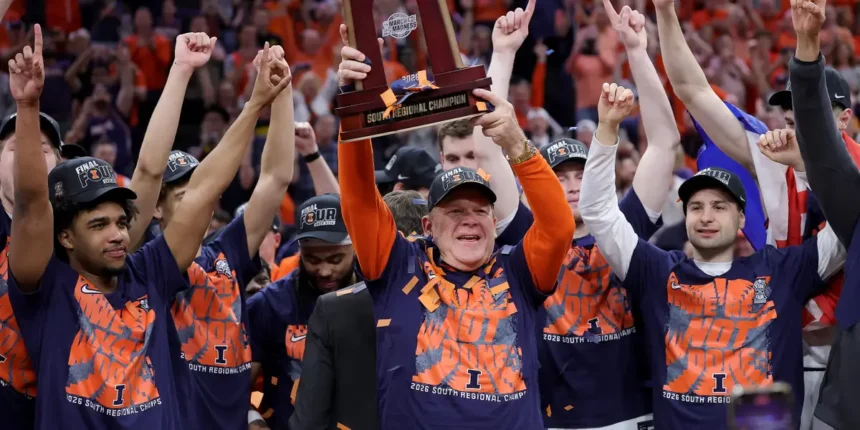
This dynamic is comparable to recent NCAA basketball tournaments, where higher-seeded teams have overwhelmingly succeeded, disappointing fans hoping for Cinderella stories and surprising upsets. The shifts within college basketball—such as changes in player compensation and transfer policies—have led talented players to gravitate towards wealthier, more established programs. This trend underscores a reality in both sports and stock investments: the wealthier entities tend to consolidate their advantages, leaving lesser-known options trailing behind.
In light of these observations, investors and fans alike may want to revisit their strategies when it comes to both stocks and sports brackets. While the allure of an upset can be tempting, historical data suggests that picking based on established success may yield more favorable outcomes.