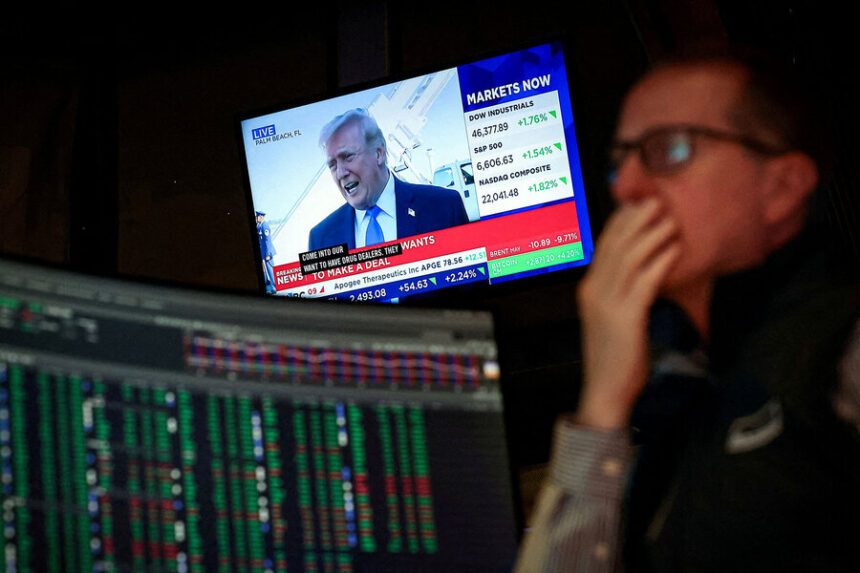
Reports are emerging concerning substantial payouts from market trades that seem to anticipate significant actions taken by the Trump administration, raising questions about potential insider information usage. Recent trading spikes in the oil futures market, just minutes before President Donald Trump announced a pause in military action against Iranian power plants, highlight this issue. According to the Financial Times, over $500 million in trades were executed by unidentified parties shortly prior to the announcement.
Moreover, the prediction market Polymarket has witnessed a notable increase in bets aligning with significant military actions taken by the U.S., including its recent incursions into Iran and Venezuela. Critics allege that this trend indicates insider trading, suggesting that traders are gaining access to confidential information that directly influences market outcomes. Such actions are challenging the integrity of market operations as legislators work to address these concerns.
Democratic Senator Chris Murphy from Connecticut has voiced strong suspicions, claiming that a set of wealthy traders holds an unfair advantage due to their access to privileged information. “This is just astounding corruption,” he remarked in a social media video, highlighting the implications of wealthy individuals profiting from their insider knowledge about government actions.
In response to the growing scrutiny, the White House has categorically denied any misconduct on the part of administration officials. Deputy White House Press Secretary Kush Desai emphasized that the administration’s focus remains on the welfare of the American populace, dismissing implications of illegal profiteering as unfounded and irresponsible.
Amid these allegations, a surge of legislation has emerged in both houses of Congress. Senator Murphy, alongside Representative Greg Casar of Texas, has introduced a measure aimed at prohibiting prediction markets from placing wagers on government decisions related to terrorism, war, assassination, or anything where outcomes are predetermined by individuals in power. Experts, however, caution that merely instituting new laws may not address the enforcement challenges that already exist in regulating insider trading.
The Commodity Futures Trading Commission (CFTC) oversees prediction markets and commodity futures, yet it faces significant resource constraints, often hindering its enforcement capability. Many trading activities on platforms like Polymarket occur offshore, compounded by the fact that users may employ virtual private networks (VPNs) to circumvent U.S. regulations.
Specific calls for reform have also included proposals to restrict stock trading by members of Congress, particularly as concerns about conflicts of interest grow. Increasing scrutiny on Trump’s personal wealth—which has soared to an estimated $6.5 billion—has coincided with legislative moves seeking greater accountability from public figures related to market activities.
As public trust in government dwindles, with only 17% of citizens believing federal officials act in the nation’s best interest compared to 77% in 1964, ethics experts emphasize the need for stricter norms preventing officials from capitalizing on their governmental roles. Some analysts contend that the more significant issue is a broader public corruption problem, sparked by excessive government involvement in markets.
In an effort to preemptively tackle these concerns, both Polymarket and Kalshi implemented policy changes aimed at curbing insider trading practices. However, industry responses have garnered skepticism, leading to further legislative proposals aimed at limiting prediction contracts tied to sports and expanding state regulatory powers over these markets.
The issue of prediction markets has gained international attention, with incidents such as an Israeli journalist being pressured to alter a blog post regarding an Iranian missile strike for financial gain revealing the potential for ethical dilemmas and dangerous coercion.
Concerns about insider trading first surfaced amidst President Trump’s trade wars, which caused significant stock market fluctuations. Reports indicated that numerous congressional aides and Executive Branch employees sold stocks strategically right before major tariff announcements, raising alarms about unethical trading practices.
Ultimately, the challenge of regulating prediction markets remains a critical discussion point within Congress, with lawmakers contemplating the broader implications of commodifying vital national issues. Senator Murphy articulated this dilemma during a recent press conference, questioning the moral ramifications of treating every significant issue as a market commodity.