Until recently, major stock indexes on Wall Street had been performing exceptionally well, with the Dow Jones Industrial Average, benchmark S&P 500, and the tech-driven Nasdaq Composite achieving record-closing highs over the past six months. However, the landscape has shifted dramatically in the past five weeks, with many investors linking this downturn to geopolitical tensions and energy supply issues stemming from the ongoing conflict in Iran.
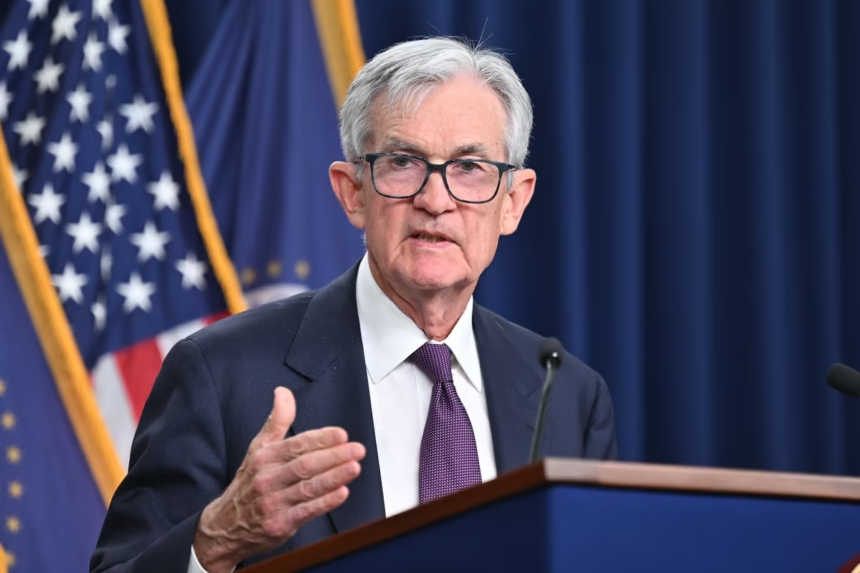
Yet, beneath these external pressures lies another significant factor—an imminent and historic transition within the Federal Reserve. Jerome Powell’s term as Federal Reserve Chair is set to expire on May 15, and while this date has been known for some time, it signifies a pivotal moment for the Fed and the broader financial market.
Powell initially assumed leadership of the Fed after being nominated by former President Donald Trump, a tenure marked by subsequent reappointment by President Joe Biden. However, signs have emerged indicating that Powell may not secure a third term. Since Trump re-entered the political arena, he has consistently criticized Powell and the Federal Open Market Committee (FOMC) for their cautious approach to interest rate cuts. Trump has publicly expressed a desire for federal funds rates to fall to 1% or lower, a significant decrease from the current range of 3.50% to 3.75%. Such reductions could ease the burden of the nation’s growing debt and lower borrowing costs for businesses, potentially stimulating hiring and innovation.
Despite these pressures, Powell has adhered to the Fed’s dual mandate, emphasizing price stability and maximum employment, based on economic data rather than political suggestions. This strategy has witnessed six rate cuts since September 2024, but it hasn’t satisfied Trump’s demands.
In a notable development, Trump nominated Kevin Warsh, a former member of the FOMC, to succeed Powell. Warsh’s brief tenure on the Board of Governors of the Federal Reserve adds an element of complexity to his candidacy. While he played a crucial role during the financial crisis, his hawkish stance could clash with both Trump’s wishes and Wall Street’s expectations. Traditionally, “hawks” prioritize controlling inflation over other economic goals, often resisting calls for aggressive monetary easing. Given Warsh’s historical reluctance to support rate cuts even during economic downturns, his selection may present challenges for a stock market that has been hinging on the prospect of continued lower rates to support further growth.
Commentators have noted that Trump’s selection might not align with the market’s aspirations, highlighting concerns that Warsh’s previous advocacy for higher rates could amplify investor anxieties. In addition, Warsh has voiced criticism over the Fed’s sizable balance sheet—having risen dramatically from less than $900 billion in 2008 to nearly $9 trillion by early 2022. His preference for a more passive Federal Reserve approach would likely involve selling off substantial portions of U.S. Treasury bonds and mortgage-backed securities.
This brings potential complications for the bond market, where higher yields, resulting from such asset sales, could ultimately lead to increased borrowing costs. As bond yields rise in response to lower prices, the ramifications could negate any expectations for further rate cuts.
Typically, a new appointment at the Fed would not cause alarm for the stock market. However, current valuations are at a historically high point—second only to January 1871—complicated by factors like the potential fallout from the Iran conflict and Warsh’s hawkish tendencies.
In a market already saturated with high valuations, a shift toward rising rates rather than cuts appears increasingly plausible in 2026, presenting a considerable obstacle for investors and raising concerns about the future trajectory of the major stock indexes.