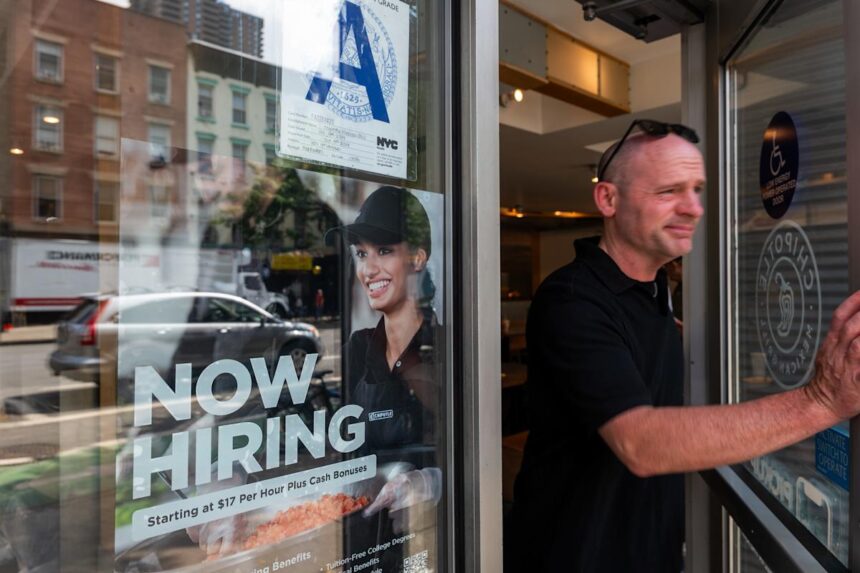
In March, the U.S. labor market exhibited unexpected resilience, with the economy adding 178,000 jobs following a revised loss of 133,000 in February. The unemployment rate dipped slightly to 4.3%, suggesting a potential rebound. However, beneath this seemingly positive development lies a more complicated narrative characterized by volatility.
Data from the Labor Department reveals that for nearly a year, the labor market has oscillated sharply, with monthly job growth alternating between gains and losses. Over the past three months alone, the figures have staggered from a gain of 160,000 to a loss of 133,000 and then to the recent gain of 178,000. This erratic behavior has turned the monthly payroll reports into events that feel significant yet lack consistent meaning.
Historically, such fluctuations have been rare. A review of payroll figures dating back to 1939 indicates that only two previous instances show a similar pattern of alternating job growth over several months: one in 1959 lasting five months and another from late 1969 into early 1970. If one were to visualize the current employment data as a stock market chart, it might resemble a broadening megaphone pattern, indicating increasing swings and a lack of consensus on the labor market’s trajectory.
Despite the recent uptick in job numbers, the longer-term trend reveals a cooling labor market. The 12-month average for net payroll growth has dwindled to about 20,000 jobs per month. Thus, while the headlines fluctuate between optimism and pessimism, the underlying context points towards a gradual weakening.
These mixed signals pose challenges for various stakeholders. For workers, while the broader headline suggests job creation is ongoing, the reality looks less promising. The proportion of individuals unemployed for 27 weeks or longer increased in March, and the ranks of “marginally attached” and discouraged workers are also climbing. Although layoffs remain relatively low, re-entering the workforce is becoming increasingly difficult for those already on the sidelines.
For employers, the situation offers a different type of uncertainty. The March job growth indicates some firms are still actively hiring, yet the pattern lacks the consistency or confidence typically associated with healthy labor market conditions. Notably, a significant portion of the job gains in March derived from the healthcare sector, which recovered after being impacted by a strike-related distortion in February, adding 90,000 jobs.
As the labor market continues to display such contradictory signals, stakeholders across the board must grapple with the implications of fluctuating employment trends, attempting to navigate a landscape that remains both unpredictable and complex.