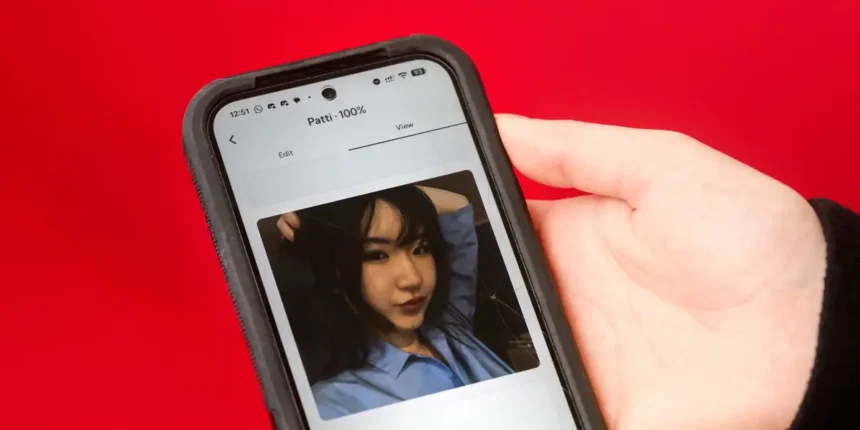
In a city renowned for its innovation and technological advancements, the dating scene in San Francisco has become an ongoing topic of discussion, especially for newcomers like 21-year-old Patricia Tani. Upon her arrival last year, she quickly heard the adage: “The odds are good, but the goods are odd.” Despite the higher male population, Tani struggled with popular dating apps like Tinder, Bumble, and Hinge, finding San Franciscans overly preoccupied with their careers to genuinely pursue romantic relationships.
Frustrated by the ineffectiveness of digital matchmaking, Tani, who co-founded the gig-work platform RentAHuman, decided to take a different approach. Ahead of Valentine’s Day, she offered a $200 bounty on her company’s website for someone to join her for a date. Tani specified her ideal match as a “sigma nerd” who could enjoy a mix of dining and casual strolls while showcasing what she humorously termed “rizz” (charisma) and “autizz” (authenticity).
The response was significant, with around 200 individuals applying. Among them stood out Jonathan Liu, a 23-year-old who created a “rizz keyboard” to help people craft better messages on dating platforms. Having initially crossed paths with Tani at a party where he felt too shy to approach her, he decided to apply for her bounty, drawn by the humorous twist of the situation.
Their Valentine’s Day dinner at the upscale Indian restaurant Copra was an experience Tani felt highlighted the inadequacies of dating apps. After dining, they went to a club, and while the evening was enjoyable, it embodied a sentiment many share about modern dating: that the traditional methods of digital matchmaking have shortcomings.
The landscape of dating apps appears to be shifting. Reports have noted a decline in paying users on platforms like Tinder and Bumble as users grow weary of the swiping model. Matchmaker and dating coach Blaine Anderson mentioned a growing desire among individuals to abandon these apps altogether, marking a backlash against the seduction of endless choices that often leads to “infinite indifference.”
Various innovative alternatives are emerging in San Francisco, with startups aiming to revitalize the dating experience. For instance, the app Known employs a voice-based artificial intelligence system that matches users on values rather than interests. The onboarding process involves in-depth conversations with the AI about personal preferences, desires, and relationship dynamics, promising a tailored match rather than an overwhelming list of options. Known has already attracted a considerable number of users, signaling a demand for more personalized matchmaking experiences in a city saturated with potential matches.
Critics, however, caution against relying solely on technology. While algorithms can evaluate quantitative features like height or interests, the more nuanced aspects of human connections—shared humor, chemistry, and emotional alignment—remain challenging to quantify. Anderson’s attempts to automate matchmaking through AI did not yield successful matches, reflecting the complexities of human relationships that cannot be reduced to mere data points.
In a bold move highlighting this shift, Anderson launched a platform called Bring Me Bae, where singles could post bounties of up to $30,000 for finding a compatible partner. The financial incentive is aimed at attracting committed individuals rather than those looking for casual flings. Initial responses have shown promise, with several successful matches occurring through the platform, although traditional notions of dating and relationship-building remain pivotal.
With the rise of in-person dating events, many young people are increasingly eager to meet others in tangible spaces. One such event, known as “The Night We Met,” was hosted by Known, where attendees were encouraged to mingle outside the tech-dominated digital realm. Observers noted a palpable shift among participants, many of whom expressed a desire for authentic connections rather than app-generated matches.
Tani’s experience with her Valentine’s Day date serves as a microcosm of the broader dating dilemmas faced by her generation. Her reflections—marred by both excitement and a sense of disillusionment—underscore the complexities of the modern dating scene. While she felt a connection with Liu, he described their outing as more akin to networking than romance, highlighting the uncertainties that still shroud dating in an age where technology plays an omnipresent role.
As the conversation surrounding dating evolves, it poses significant questions about the balance between technological solutions and the essential human elements of connection, self-discovery, and genuine relationships in a world increasingly dominated by screens and algorithms.