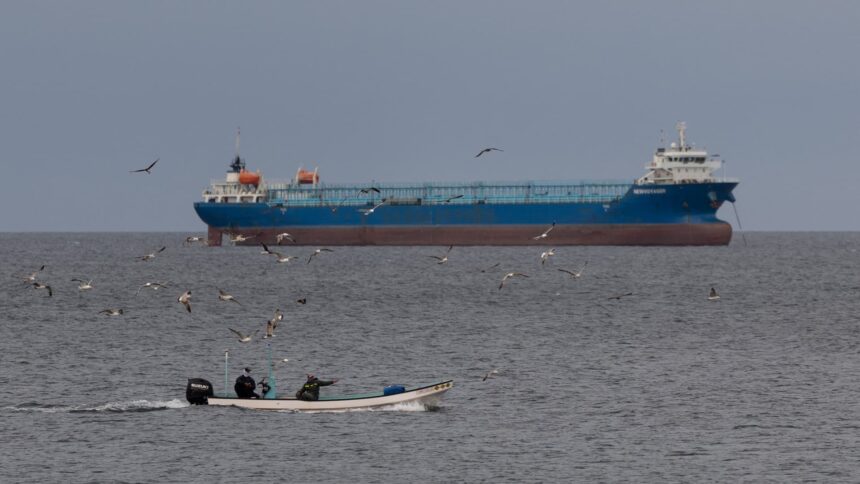
A small fishing vessel passed by as the tension in the Middle East escalated, with a significant U.S.-Israeli conflict against Iran unfolding off Sultan Qaboos Port in Muscat, Oman. On Sunday, President Donald Trump issued stern warnings regarding Iran’s control over the Strait of Hormuz, a vital passage for global oil shipping, emphasizing that U.S. military action could begin soon if the strait was not reopened.
Trump’s threats came after U.S. forces successfully recovered an American airman from Iranian capture. In a post on social media, he declared his intent to unleash severe repercussions on Iran, stating that a deadline of “Tuesday 8 P.M. Eastern Time” had been set for Iran to agree to terms with the United States. The White House later confirmed that this date was critical for ongoing negotiations.
In response, Iran firmly rejected Trump’s ultimatum, asserting that full reopening of the Strait would not occur until damages from the conflict were addressed. Tehran’s military actions persisted, targeting regional economic infrastructures, including strikes on Kuwait’s oil headquarters.
Despite the rising tensions, hopes of a ceasefire loomed as reports indicated that Washington and Tehran were engaged in discussions mediated by Gulf states. A potential 45-day ceasefire was on the table, although analysts considered the likelihood of an agreement before the imminent Tuesday deadline slim. Homin Lin, a senior macro strategist, remarked on the cautious trading atmosphere, suggesting that market reactions could fluctuate substantially based on developments.
On the trading front, Japanese and South Korean stocks showed an upward trend as investors remained attentive to the unfolding geopolitical situation. The Nikkei 225 rose by 1.2%, while South Korea’s Kospi gained 0.8%. However, other markets, including India’s Nifty 50, experienced declines.
Many key Asian markets were closed for holiday observances, including Easter celebrations in Australia, New Zealand, and Hong Kong, as well as China’s Qingming Festival. Meanwhile, the Organization of the Petroleum Exporting Countries (OPEC) and its allies announced an increase in production quotas by 206,000 barrels per day for May, a move that analysts viewed as largely symbolic due to the ongoing war’s impact on member countries’ shipment abilities.
In the commodities market, oil prices surged, with U.S. West Texas Intermediate climbing by 2.57% to $114.11 per barrel, while the international benchmark Brent crude rose by approximately 2.62% to $111.65 per barrel. With uncertainty hovering over the Middle East, analysts suggest that market volatility will likely persist as investors await clarity on the region’s future actions.