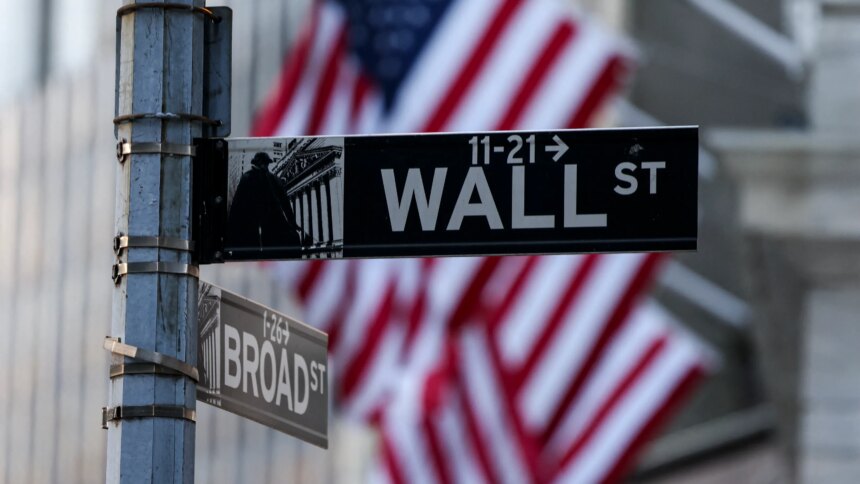
Wall Street’s major indexes experienced modest gains on Monday following their most substantial weekly surge in four months, as investors continued to evaluate the potential for a resolution to the ongoing conflict in the Middle East. Negotiations between the U.S. and Iran reportedly focused on a framework for peace, although Iran has dismissed suggestions for a prompt reopening of the vital Strait of Hormuz. President Donald Trump has set a deadline for Tuesday regarding the waterway’s accessibility.
Despite the tensions, a report emerged indicating that the U.S., Iran, and regional mediators were engaged in discussions about a possible 45-day ceasefire, providing some optimism to the markets. “The stock market is a very good barometer of future activities … investors are expecting a recovery from the selloff that we experienced,” commented Sam Stovall, chief investment strategist at CFRA Research. He noted that Wall Street appears to be adopting a cautious wait-and-see approach while anticipating a positive outcome.
The S&P 500’s information technology sector emerged as the strongest performer, climbing 0.4%, driven largely by strong performances in the semiconductor industry. Notably, Seagate, a memory chip manufacturer, saw an 8.3% increase after being added to Morgan Stanley’s top-pick list. The Philadelphia SE Semiconductor index also recorded a 0.8% gain. Conversely, industrials and mining stocks faced declines, falling 0.3% and 0.7%, respectively.
At 10:02 a.m. ET, the Dow Jones Industrial Average rose by 68.86 points, or 0.15%, reaching 46,573.53. Meanwhile, the S&P 500 gained 22.22 points, or 0.31%, to 6,604.91, and the Nasdaq Composite increased by 117.62 points, or 0.52%, to 21,992.14. However, trading volumes were anticipated to be lower than usual due to market closures in Europe and Asia for public holidays.
The CBOE Volatility Index, often referred to as Wall Street’s “fear gauge,” increased slightly by 0.47 points to settle at 24.34. Pete Mulmat, head of brokerage strategy and operations at IG North America, noted that both stock prices and the VIX index were rising simultaneously, indicating that the markets were responding to Trump’s “deadline extension” rather than genuine optimism.
Last week marked the first weekly gains for the main indexes in six weeks, driven by alleviated concerns over the conflict. Investors were also set to closely monitor domestic inflation metrics this week, especially to assess if the spikes in energy prices due to the conflict have affected the U.S. economy. Recent data showed an unexpected rebound in U.S. job growth in March, suggesting the Federal Reserve might maintain its interest rate position. Currently, money market participants do not expect any reductions in rates this year, contrary to earlier projections of two cuts prior to the outbreak of the conflict.
The Institute for Supply Management’s non-manufacturing purchasing managers’ index for March was released on Monday, indicating a reading of 54, slightly below economists’ expectations of 54.9.
In other notable market movements, Soleno Therapeutics saw its shares soar approximately 32% after Neurocrine Biosciences agreed to acquire the rare-disease drugmaker for $2.9 billion in cash. Meanwhile, U.S.-listed cryptocurrency firms witnessed gains, with Coinbase and Strategy climbing 2% and 4.3%, respectively, as Bitcoin prices saw a slight uptick.
Overall, advancing issues outpaced decliners on both the NYSE and Nasdaq, with a ratio of 1.48-to-1 and 1.81-to-1, respectively. The S&P 500 recorded five new 52-week highs alongside one new low, while the Nasdaq Composite noted 37 new highs and 31 new lows.