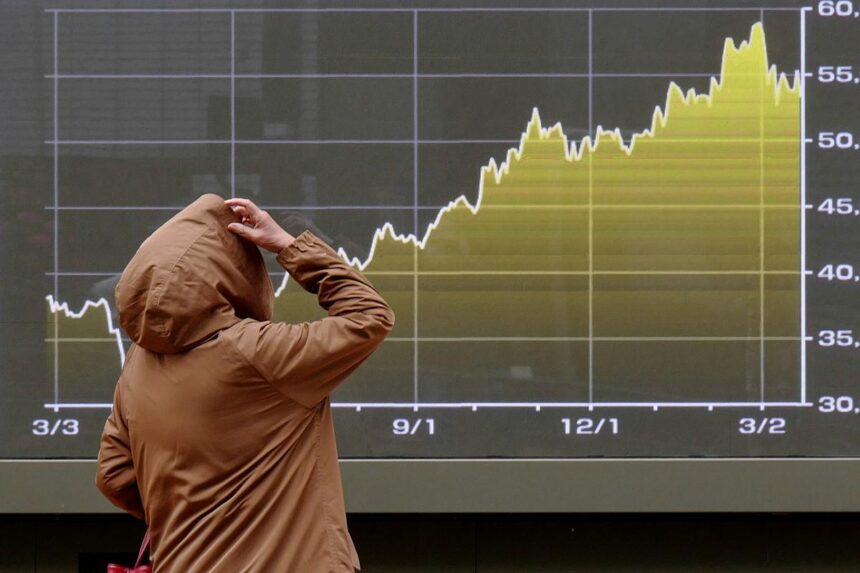
In recent years, American households have increasingly invested their wealth in the stock market, leading to a sense of financial security as stock prices soared to record highs. However, the ongoing conflict in Iran has started to create concern among investors, potentially exposing them to significant market pullbacks.
According to a note from UBS, equity investments now make up nearly 40% of U.S. household net worth. This represents a substantial increase compared to the 10%-20% range seen during the oil price shocks of the 1990s. UBS economist Arend Kapteyn explained that this shift means household balance sheets—and, by extension, consumer spending—are now more sensitive to fluctuations in financial markets than in past decades.
As geopolitical tensions have intensified, all three major U.S. stock market indexes have slipped into negative territory for the year. The Dow Jones Industrial Average has fallen approximately 3%, the Nasdaq is down 5%, and the S&P 500 has also decreased by 3%. In response to these market conditions, Wells Fargo has lowered its year-end target for the S&P 500 from 7,800 to 7,300, indicating a bearish outlook.
Consumer behavior is often influenced by the so-called “wealth effect,” where rising stock prices and home values lead households to spend more due to a heightened sense of financial security. Conversely, a decline in stock values may dampen consumer spending, particularly impacting lower-income households disproportionately. This growing economic divide raises concerns as consumer spending constitutes around two-thirds of U.S. gross domestic product. Citi analyst Steven Zaccone highlighted that if this pullback occurs, broader economic worries are likely to surface.
Recent surveys from the University of Michigan show a notable decline in consumer sentiment across all demographics, particularly among those in the middle and higher-income brackets. Joanne Hsu, the survey’s director, indicated that rising gas prices and market volatility due to the Iran conflict have negatively affected consumer outlooks.
Despite these emerging challenges, the U.S. economy has shown resilience. Recent job reports indicate a decrease in unemployment, and retail sales remained robust in February, though much of this data was collected before the latest conflict escalated.
Market strategists suggest that unlike previous oil shocks, more Americans are now serious about investing, partly due to the decline of traditional pension systems. John Stoltzfus of Oppenheimer noted that multiple generations have come to realize that Social Security may not provide the same level of support in retirement as it once did for earlier generations. While many investors are adopting a cautious approach, there are still instances of risk-taking behaviors prevalent in the market, with attention given to volatile assets such as cryptocurrencies and meme stocks.
As investors look to the future, some analysts are optimistic. Brian Jacobsen from Annex Wealth Management suggested that corporate America continues to show resilience in profit generation. He expressed confidence that, despite current turmoil, major indices could see gains in the year ahead, depending on the length and resolution of international conflicts.
Overall, while the immediate outlook appears uncertain, many believe that a recovery may be possible if corporate fundamentals remain strong and the geopolitical landscape stabilizes.