U.S. stock futures experienced a significant upswing following President Donald Trump’s announcement to suspend attacks on Iran for a two-week period. This pause comes just before his 8 p.m. ET deadline and marks a temporary halt in a five-week conflict that has had substantial implications for the global energy supply, notably closing the vital Strait of Hormuz.
Futures connected to the Dow Jones Industrial Average surged by 967 points, equating to a 2.1% increase. Similarly, S&P 500 futures also gained 2.1%, while Nasdaq 100 futures rose by 2.3%. In reaction to the announcement, West Texas Intermediate crude futures saw a steep decline, dropping around 18% to below $93 a barrel.
In his post on Truth Social, Trump stated, “I agree to suspend the bombing and attack of Iran for a period of two weeks,” adding that the U.S. had received a “10 point proposal from Iran” which he deemed “workable for negotiation.” Importantly, the ceasefire comes with conditions; Trump specified that it hinges on Iran’s agreement to reopen the Strait of Hormuz, a strategic waterway crucial for global oil transit. Iran’s Foreign Minister confirmed that the Supreme National Security Council has committed to reopening the waterway for two weeks, provided that all attacks cease and that movements are coordinated with Iran’s Armed Forces. Reports indicate that Israel is also in agreement with the truce.
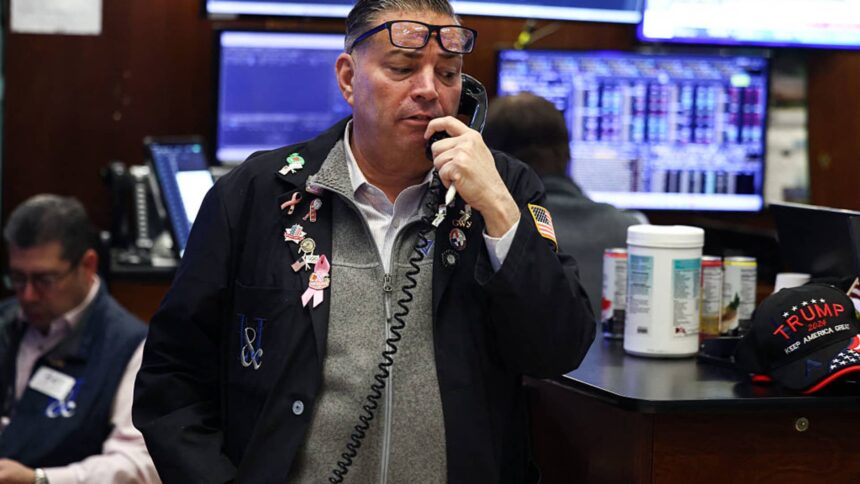
Market analysts noted that the announcement did not come as a complete shock. Jay Woods, chief market strategist for Freedom Capital Markets, mentioned that the market has become increasingly adept at anticipating Trump’s maneuvers. He raised concerns about whether this “two-week” timeframe could lead to a sustainable resolution.
Prior to Trump’s announcement, the S&P 500 had gained a modest 0.08% during Tuesday’s trading, spurred by optimism regarding a potential ceasefire. The Nasdaq Composite rose slightly by 0.10%, whereas the Dow registered a minor loss of 85.42 points. Stocks had rebounded in the final trading hour of Tuesday after Pakistan’s Prime Minister Shehbaz Sharif requested Trump to extend the deadline by another two weeks and urged Tehran to open the Strait of Hormuz as a goodwill gesture.
Just before the announcement, Trump had threatened severe action against Iran, including targeting its power plants and bridges, should an agreement not be reached to reopen the strategic waterway. At that point, the S&P 500 was about 5.5% off its all-time high from earlier this year, reflecting the market’s heightened anxiety over the conflict’s potential impact on both the U.S. and the global economy. The conflict had previously led the S&P 500 to approach a 10% correction before showing signs of recovery amid hopes for diplomatic resolutions.
The escalating tensions and subsequent disruptions had already driven crude oil prices up over 70% this year, contributing to an average U.S. national gasoline price surpassing $4 a gallon for the first time since 2022, according to AAA.
In corporate news, Delta Air Lines is scheduled to release its earnings report prior to the stock market opening on Wednesday, a development that investors will be closely watching amidst the broader economic climate.