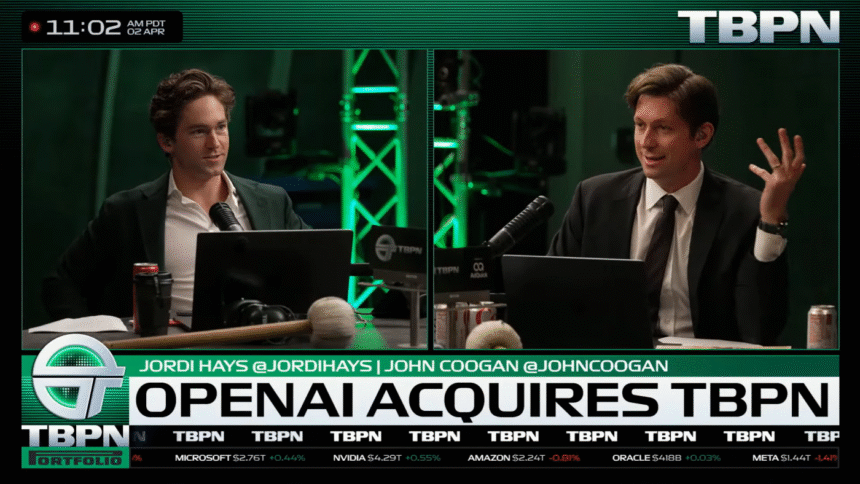
Last week, the tech community was abuzz with news of OpenAI’s acquisition of the Technology Business Programming Network (TBPN), a streaming talk show with a devoted following among Silicon Valley insiders. Many initially dismissed the announcement as an elaborate April Fools’ prank, a sentiment humorously acknowledged by TBPN co-host Jordi Hays during a recent livestream. As co-founder John Coogan introduced the segment, Hays quipped about the timing, saying, “It is 364 days until April Fool’s,” before Coogan reassured viewers that, indeed, the news was legitimate.
This purchase marks OpenAI’s strategic expansion into media, coming just weeks after executives urged employees to rein in extracurricular projects, having recently halted its AI video app Sora and paused a controversial plan to launch an erotic chatbot. The acquisition of TBPN, however, signals an intention to influence the public dialogue surrounding artificial intelligence, as awareness and scrutiny of the technology continue to grow. University of Washington professor Margaret O’Mara remarked that the move allows OpenAI to engage with a niche audience, aiming to control the narrative within a competitive tech landscape.
Billed as the “SportsCenter for Silicon Valley,” TBPN debuted in October 2024 as the Technology Brothers Podcast, later rebranding in March 2025. The daily livestream features a lively mixture of interviews with influential figures, tech gossip, and celebrations of entrepreneurial successes, often culminating in the ringing of a giant gong. Though not a mainstream program—counting approximately 345,000 followers on X and 74,000 subscribers on YouTube—it has managed to cultivate a dedicated listenership of startup founders, investors, and executives, including OpenAI CEO Sam Altman, who considers it his favorite tech show.
Altman, who has forged a long-standing friendship with Coogan, has made several appearances on TBPN, joining the ranks of other high-profile guests like Meta CEO Mark Zuckerberg and Microsoft chief Satya Nadella. The show’s optimistic take on technology resonates with its audience, gathering support among those who generally view Silicon Valley’s developments positively, as noted by media strategist Elizabeth Spiers.
In an official statement following the acquisition, OpenAI’s Fidji Simo expressed the company’s aim to foster a constructive dialogue about AI among stakeholders. She assured audiences that TBPN would retain editorial independence while integrating the show’s talent to enhance communication about AI’s societal impacts.
However, this acquisition occurs amid rising public anxiety regarding artificial intelligence. Growing skepticism about AI’s benefits was highlighted in a recent NBC News poll, which revealed that many American voters perceive its risks to outweigh the advantages, with concerns about environmental impacts and job losses due to automation. Altman himself admitted to underestimating the level of distrust towards AI, especially in light of controversies such as rival Anthropic’s ongoing issues relating to military applications of the technology.
Moreover, there has been notable turnover within AI companies, with some employees stepping away from the field entirely to pursue other interests, as highlighted by tech critic Sara M. Watson. She pointed out the importance of balancing public discourse with a more optimistic viewpoint, suggesting that a narrative shift is essential amid prevailing concerns.
Historically, tech firms have sought to mitigate negative perceptions through media ventures, a trend that stretches back decades. By purchasing or creating their own platforms, companies aim to exert influence over the narratives that define them. OpenAI’s latest move aligns with this trend, yet it raises questions about potential biases in TBPN’s content, especially as it appears under the operational umbrella of a major player in the AI field. O’Mara cautioned that while the intention might be to produce informative content, the risk exists that audiences could view TBPN as merely an extension of OpenAI’s public relations efforts rather than as an independent journalistic outlet.