Oil and gas prices experienced a notable rise on Thursday as tensions in the Middle East escalated, putting a strain on a recently announced ceasefire between the US and Iran. Amid continued Israeli attacks on Lebanon and escalating threats of renewed military action from both Tehran and Washington, market investors reacted cautiously.
The two-week ceasefire, intended to ease hostilities and allow for the reopening of the strategic Strait of Hormuz, appeared increasingly fragile just a day after its announcement. Brent crude oil, a global benchmark, surged by 3.5%, settling at $98.10 per barrel, while New York light crude also rose by 3.7%, reaching $98 a barrel. This rebound follows a significant drop on Wednesday when Brent crude plummeted by 13.3% to a four-week low of $94.75.
In the gas markets, prices began to increase again. The month-ahead UK gas contract rose by 2.8% to 117.50p per therm, recovering from a 15% decline on Wednesday after the ceasefire was revealed. Similarly, European natural gas futures approached €46 per megawatt hour, rebounding from a five-week low after experiencing a nearly 15% drop to €45.30.
The situation has intensified further with the UAE and Kuwait confirming that their air defenses intercepted Iranian drones. Iranian parliament speaker Mohammad Bagher Ghalibaf accused Israel and the US of violating multiple provisions of the ceasefire agreement. Additionally, Iran’s Revolutionary Guards issued a warning of a “regret-inducing response” if Israel did not cease its strikes on Lebanon. Reports indicate that the Israel-led missile onslaught, the most severe since the conflict began, resulted in at least 254 deaths and over 837 injuries, significantly disrupting oil tanker traffic through the Strait of Hormuz.
Former President Donald Trump took to his Truth Social platform, asserting that US military forces would remain in the region until a comprehensive agreement was fully enforced. He cautioned that failure to comply with the terms of the deal would trigger a level of military action unprecedented in scale.
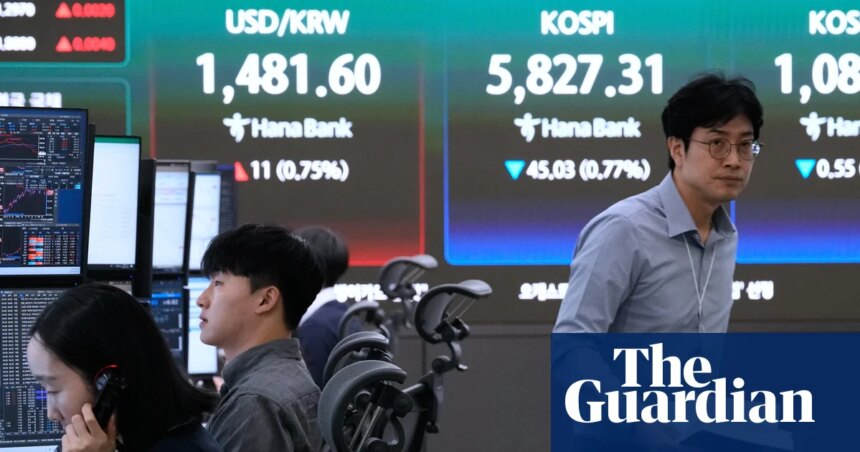
Asian stock markets reflected the rising tensions, with Japan’s Nikkei index dropping 0.7% after a 5.4% rise the previous day. South Korea’s Kospi fell by 1.7% following a 7.5% increase, while Hong Kong’s Hang Seng index declined by 0.4%. European stock indices also opened lower; the UK’s FTSE 100 slipped 0.3%, Germany’s DAX fell 1.2%, France’s CAC dropped 0.75%, and Italy’s FTSE MiB was down 0.3%. The pan-European Stoxx 600 index experienced a decline of 0.7%, reversing some of the gains made from the previous day’s rally.
US stock futures indicated a lower opening for Wall Street later in the day. However, optimism was noted by Jim Reid, a strategist at Deutsche Bank, who indicated that market stress had eased significantly compared to the previous 24 hours. He attributed this partial relief to both the ceasefire news and hopes for a path to de-escalation, stating that fears of a stagflationary shock had diminished.
On the diplomatic front, a sign of progress emerged as White House press secretary Karoline Leavitt announced that Vice President JD Vance would lead a delegation to Islamabad for a first round of talks scheduled for Saturday morning.
Despite the precarious state of the ceasefire, Mohit Kumar, chief European economist at Jefferies, expressed a belief that the truce would hold. He attributed this to the principle of mutually assured destruction (MAD), suggesting that continued conflict would prove detrimental for both sides. Trump’s desire for a deal, along with the realization from the US and Israel that the ongoing conflict is unsustainable without finding solutions to drone interceptor technology and securing passage through the Strait of Hormuz, further supports this notion.