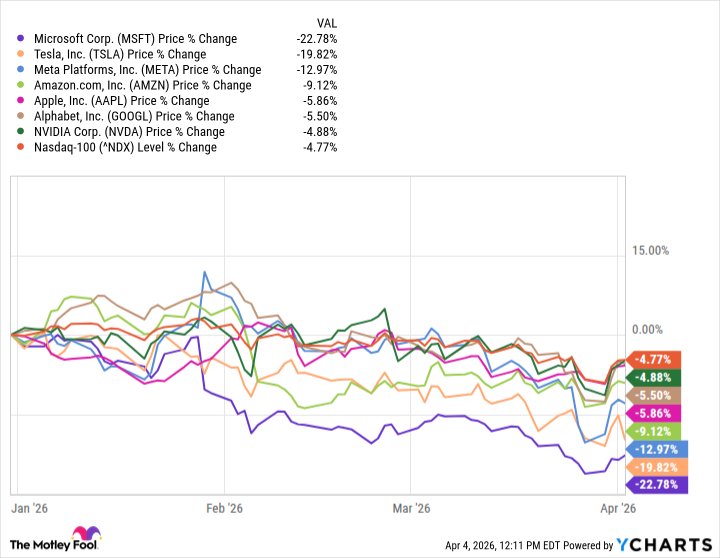
In 2023, Wall Street analyst Michael Hartnett characterized a select group of America’s leading companies as the “Magnificent Seven.” This label highlights their significant influence in the technology sector and their remarkable capacity for generating faster revenue and earnings growth compared to the wider market. The companies included in this elite group are Nvidia, Apple, Alphabet (parent of Google), Microsoft, Amazon, Meta Platforms, and Tesla.
Despite their historical performance, the Magnificent Seven are currently facing a unique challenge. The Nasdaq-100 index has seen a decline of 4.8% in 2026, largely driven by ongoing geopolitical tensions in the Middle East. In a striking contrast, the average stock within the Magnificent Seven has experienced a more significant year-to-date drop of 11.5%.
High-growth stocks like those in the Magnificent Seven tend to exhibit greater volatility, particularly during periods of uncertainty. Nonetheless, this fluctuation also presents potential buying opportunities for investors eager to take advantage of diminished prices. Among the group, Amazon and Alphabet stand out as attractive investments at this juncture.
Amazon has its roots as a pioneering force in the e-commerce landscape since the late 1990s. While its retail platform remains a major revenue source, the company has diversified into other areas such as streaming, digital advertising, and notably, cloud computing. Amazon Web Services (AWS) has emerged as the leading player in the cloud industry, offering a wide array of services designed to support businesses in the digital age—from basic data storage solutions to sophisticated software development tools. AWS has become central to Amazon’s artificial intelligence (AI) endeavors, operating hundreds of specialized data centers worldwide and renting computing capacity to firms developing AI technologies.
Notably, Amazon has developed its own AI chips such as the Trainium series, which deliver superior performance at competitive prices. AWS concluded 2025 with an impressive $244 billion backlog for computing capacity, a clear indicator of its robust demand. In 2025, AWS generated a remarkable $128.7 billion in revenue, with a fourth-quarter growth rate of 24%, signaling its strong position in the market. While Amazon’s stock price has declined by 9% in 2026 and 17% from its previous peak, its current price-to-earnings (P/E) ratio of 29.2 is nearing its lowest since going public nearly 30 years ago, presenting a compelling entry point for long-term investors.
Alphabet, as the parent company of Google, YouTube, and several other high-profile ventures, also presents an attractive investment. Its Google Cloud platform is a substantial competitor to AWS, providing a multitude of similar services. Alphabet has taken the initiative to design its own AI chips—Tensor Processing Units (TPUs)—which are specialized for AI tasks and outperform traditional graphics processing units. The latest Ironwood TPUs have played a crucial role in training Alphabet’s Gemini 3 family of large language models, widely used by over 120,000 enterprises globally.
In 2025, Google Cloud achieved a record revenue of $58.8 billion, with growth accelerating by 48% in the final quarter. Additionally, Google Search, Alphabet’s largest revenue source, showcased increasing growth through the integration of AI-driven features, drawing more users and advertisers. Currently, Alphabet’s stock trades at a P/E ratio of 27.2, making it even more appealing compared to Amazon and the Nasdaq-100 technology index.
The current stock market fluctuations may offer long-term investors a favorable entry point into both Amazon and Alphabet, as they explore their transformative roles in the tech industry. Investors looking to capitalize on the potential of high-growth stocks amidst market uncertainties could find the Magnificent Seven, particularly these two companies, worth consideration.