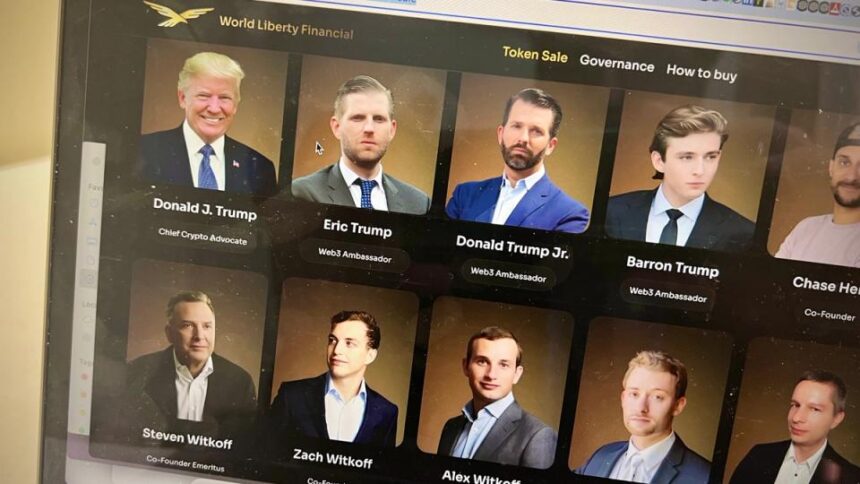
World Liberty Financial, a cryptocurrency venture co-founded by the Trump family, has recently engaged in a series of transactions via the decentralized finance (DeFi) lending protocol Dolomite that have sparked concerns regarding insider access, circular token economics, and significant risks to other depositors.
Analysis of on-chain records, including data from Etherscan, Arkham, and various publicly accessible wallet addresses, indicates that these activities commenced on February 8. On that date, WLFI’s treasury deposited 14 million USD1, its own dollar-pegged stablecoin, into Dolomite as collateral and subsequently borrowed 11.4 million USDC against it. Shortly after, 11.45 million USDC was transferred to a Coinbase Prime deposit address. Two days later, another 12.5 million USD1 was moved from the treasury to a different Coinbase Prime deposit address, indicating direct conversion from crypto to fiat or potential institutional over-the-counter trading.
Interestingly, the WLFI token became involved later on February 20, when the treasury deposited 890 million WLFI into Dolomite and secured a loan of 20 million USD1 against it. Another significant deposit of 1.1 billion WLFI followed on March 24, culminating in 1.99 billion WLFI tokens currently held as collateral in Dolomite. In total, the treasury has extracted approximately 31.4 million stablecoins from the protocol during these transactions.
Key concerns arise from the structure of these transactions and their implications for the DeFi ecosystem. The choice of Dolomite is noteworthy, as co-founder Corey Caplan serves as an advisor to World Liberty Financial. WLFI currently leads Dolomite’s supplied-assets list, boasting $458.9 million in supply liquidity, which represents roughly 55% of the protocol’s entire liquidity pool of $835.7 million.
The structural vulnerability lies especially in Dolomite’s USD1 liquidity pool. With $4.6 billion in circulation, USD1 ranks second on the protocol, showing $180 million supplied against $167.5 million borrowed—a high utilization ratio of about 93%. This level of borrowing highlights concentrated activity, indicating that everyday depositors who lent USD1 may encounter difficulty accessing their funds. Their deposits are effectively locked until the larger borrowers, like WLFI, repay their loans.
Moreover, the collateral backing the WLFI-denominated borrow presents additional risks. WLFI token trades have limited market depth in relation to the size of the position involved. Should the token’s value drop sharply, and Dolomite’s liquidation process is activated, the forced sale could lead to a rapid depreciation in price before the collateral could be unwound, resulting in bad debt that ultimately impacts retail depositors.
In April, activity intensified via alternate transactions when, on April 2, the WLFI treasury transferred 2 billion WLFI to a Gnosis Safe proxy wallet. Five days later, an additional 1 billion WLFI was sent. These transfers did not directly involve Dolomite, and on-chain data has yet to clarify the destination of these tokens, which cumulatively hold an estimated value of around $266 million at WLFI’s current price of $0.0888.
As of now, World Liberty Financial has not issued a response to inquiries regarding these transactions. This scenario raises critical questions about liquidity risks and the sustainability of practices within the DeFi space, necessitating closer scrutiny from regulators and market participants alike.