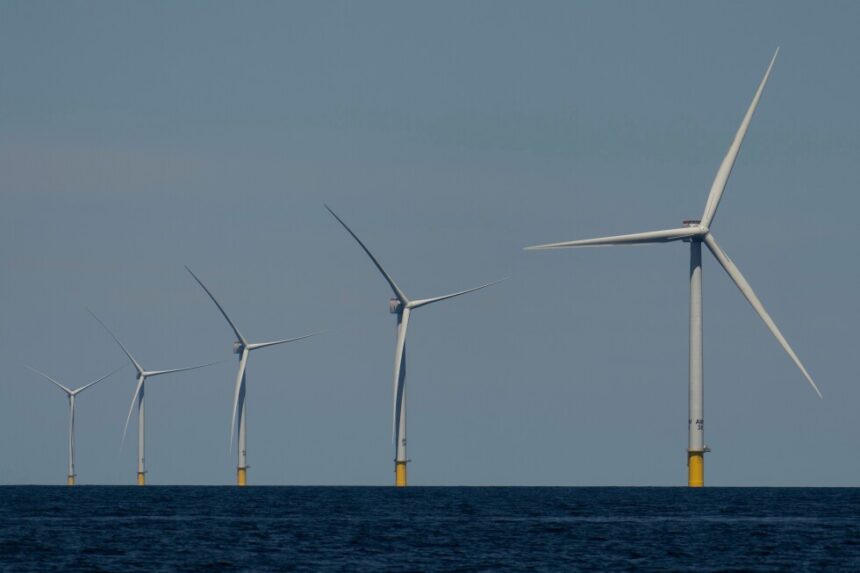
The developer behind a prominent offshore wind farm in Massachusetts has initiated legal proceedings against its turbine manufacturer, aiming to compel continued collaboration on the project. Vineyard Wind filed the lawsuit on Wednesday in Massachusetts, targeting GE Renewables after the latter’s parent company announced plans to terminate their contracts for turbine services and maintenance by the end of April.
The dispute arises amidst financial claims, with GE Vernova asserting that Vineyard Wind owes $300 million for completed work. Conversely, Vineyard Wind argues that GE Renewables is liable for approximately $545 million due to the fallout from a catastrophic turbine blade collapse in July 2024, which both delayed the project and resulted in significant damages.
In the highly visible incident, fiberglass fragments from the malfunctioning blade washed up on Nantucket’s beaches during the tourist peak of July, prompting GE Vernova to settle for $10.5 million with local businesses that faced economic losses.
Vineyard Wind’s lawsuit criticizes GE Renewables for what it describes as “inexcusably poor performance,” claiming that allowing the contractor to withdraw at this stage would inflict irreparable harm to the project. Craig Gilvarg, a spokesperson for Vineyard Wind, articulated that the lawsuit aims to ensure GE Renewables fulfills its commitments to both the project and the communities of Massachusetts and New England, highlighting the anticipated $3.7 billion in savings the project is projected to deliver to electricity customers over its lifespan.
In defense, GE Vernova cited its right to discontinue agreements due to nonpayment. The company has expressed its commitment to the wind farm’s safety, standing firmly by its performance and contractual responsibilities, and signaled intentions to robustly defend its position in court.
Vineyard Wind has already seen the completion of construction as of March, marking it as the first project to reach this milestone during the Trump administration. The farm had begun supplying power to the grid prior to its completion, with expectations of reaching full operational capacity in the coming months.
The lawsuit underscores the critical role GE Renewables plays in the project, stating that it is the sole company capable of performing the remaining tasks, complicating the search for a replacement turbine supplier. A court hearing is anticipated for Thursday to address the ongoing legal contention.
GE Vernova has attributed the blade failure to insufficient bonding at one of its Canadian factories, asserting that there is no evidence of a design flaw. Out of the 72 installed blades at the time, 68 were replaced, causing a project delay of nearly two years.
The project has faced scrutiny from the Trump administration, particularly following the blade incident, which led to temporary halts on construction for several major East Coast offshore wind initiatives, citing national security concerns. However, legal challenges from developers and states allowed all five projects, including Vineyard Wind, to continue.
As a collaborative effort between Avangrid and Copenhagen Infrastructure Partners, Vineyard Wind is located approximately 15 miles south of Martha’s Vineyard and Nantucket. With 62 turbines expected to generate a total of 800 megawatts, the project aims to provide clean electricity to power approximately 400,000 homes.