In the realm of investing, stocks have historically dominated as the asset class of choice for long-term gains, far surpassing bonds, commodities, and real estate. However, the market’s upward trajectory often comes with periods of volatility and downturns, raising concerns for investors.
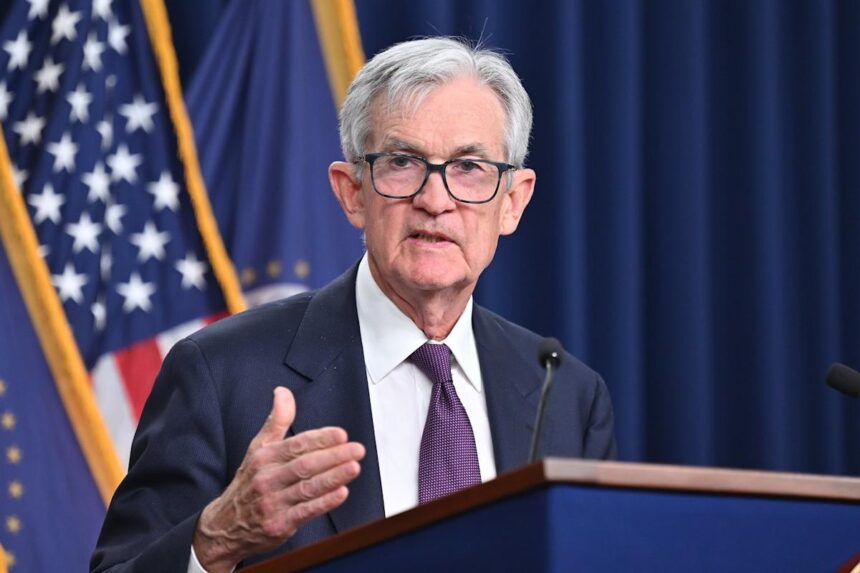
One significant warning about stock market valuations emerged from Federal Reserve Chairman Jerome Powell, who broke from tradition by directly addressing this sensitive topic. During a speech last September, Powell acknowledged the heightened valuations of equity prices, indicating that they are “fairly highly valued,” a statement that has reverberated through Wall Street for months.
Typically, the Federal Open Market Committee (FOMC) focuses on maximizing employment and stabilizing prices, steering clear of direct comments on stock market performance. Yet, on rare occasions, Fed chairs have voiced concerns regarding valuations, highlighting moments when the market was at risk. A notable example includes former Fed Chair Alan Greenspan’s infamous “irrational exuberance” speech in 1996, which preceded the dot-com bubble.
Despite Powell’s cautionary words, stock prices continued to escalate, with the S&P 500, Nasdaq Composite, and Dow Jones Industrial Average achieving significant milestones. Nonetheless, the S&P 500’s Shiller Price-to-Earnings (P/E) Ratio, which is based on average, inflation-adjusted earnings over a decade, serves as a crucial metric for assessing market value. Historically, a Shiller P/E above 30 has preceded substantial declines, and currently, the S&P 500 stands with a Shiller P/E over 40—its second-highest valuation on record.
The historical precedent indicates that a Shiller P/E above 30 during a bull market has led to market drops ranging from 20% to 89%. The ratio has only risen above 40 three times in the past 155 years, including the present era. Previous instances, like during the dot-com bubble and early 2022, resulted in peak-to-trough declines of 49% and 25%, respectively.
Inflation concerns and geopolitical tensions, such as the conflict in Iran, have contributed to market fluctuations, yet the broader trend remains one of expensive valuations. The Shiller P/E has recently climbed back above 38, foreshadowing possible significant downturns. Notably, history has shown that no major market correction has concluded with a Shiller P/E higher than 27, suggesting that a substantial drop could be on the horizon if the current patterns persist.
In light of Fed Chair Powell’s insights and the looming valuation concerns, potential investors are urged to reassess their strategies. Analysts are highlighting alternative stocks that may offer greater returns compared to the more traditional S&P 500 index. Historical examples showcase the effectiveness of such recommendations, illustrating that savvy investment choices can lead to dramatic gains.
As investors navigate this landscape, the warnings from Powell and the historical context serve as a critical reminder of the potential pitfalls associated with high valuations in the stock market.