In a bid to alleviate the financial squeeze from soaring gas prices spurred by geopolitical tensions, many drivers are turning to Native American reservations to seek out lower fuel costs. Junelle Lewis, hailing from the Seattle area, recently discovered the advantages of filling up at the Tulalip Market, located approximately 30 minutes from her home. “I purposely drove here just for the gas,” Lewis stated, as she filled her Chevrolet Suburban at $4.84 per gallon—about 75 cents cheaper than gas stations near her residence.
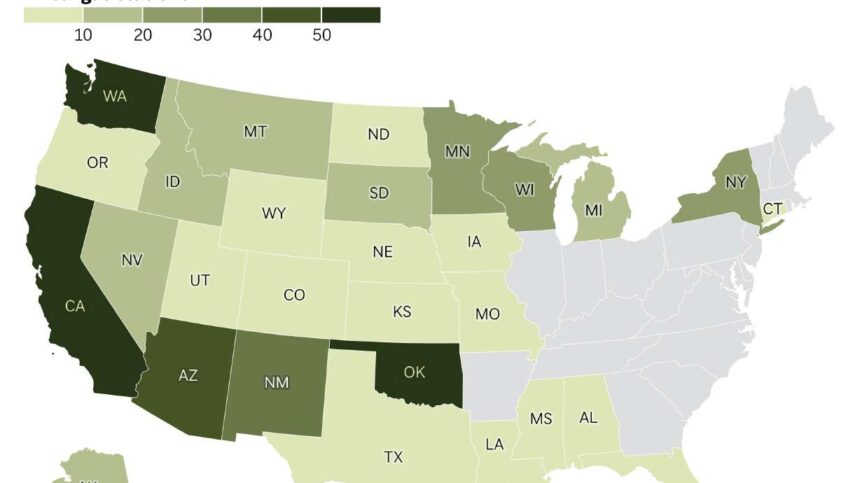
Lewis’s experience mirrors that of many drivers who have found that some fuel prices on Native American reservations are considerably lower than nearby urban stations. Tribally owned gas stations in states like California, New Mexico, New York, Oklahoma, and Washington offer competitive prices due to state fuel tax exemptions. GasBuddy, an app designed to help users find the cheapest gas, has made it easier for consumers to locate these facilities.
Nationwide, average gasoline prices have surged by more than a dollar since the onset of the Iran war on February 28, now sitting at approximately $4.15 per gallon, according to AAA. Prices peaked over $5 per gallon during the summer of 2022, and experts suggest that ongoing geopolitical unrest may continue to drive prices higher, impacting inflation.
The savings available at tribally owned convenience stores are significant. For example, at the Chukchansi Crossing Fuel Station and Travel Center in California, fuel prices peaked at $5.09—60 cents cheaper than adjacent stations. Meanwhile, on the Mescalero Apache Reservation in New Mexico, fuel was available as low as $3.79, providing relief for residents like Jamie Cross who expressed hopes that prices wouldn’t rise further.
In eastern New York, the Cattauragus Indian Territory offered gas prices around $3.65 at various stations, underscoring the affordability compared to neighboring towns.
The primary reason tribes can afford to sell gas at lower prices comes down to tax policy. While tribes are required to pay the federal fuel tax—18.4 cents per gallon for gasoline and 24.3 cents for diesel—they are generally exempt from state fuel taxes, a long-standing principle upheld by U.S. courts. This principle has been affirmed in various Supreme Court rulings, establishing that states lack the authority to impose taxes on Native Americans residing on their lands.
This tax situation varies across states, with gasoline tax rates ranging from 9 cents in Alaska to 71 cents in California. Various agreements and agreements between states and tribes further complicate this landscape, as seen in rulings like the 2019 Supreme Court decision related to the Yakama Nation’s treaty rights.
While convenience store gas sales do not yield high profit margins, they provide a gateway for tribes to offer additional goods, such as groceries, in areas often designated as food deserts. Matthew Klas, a consultant focusing on tribal businesses, emphasized the importance of these establishments for local communities lacking access to affordable food and household supplies.
Tribal gas stations, increasingly accompanied by groceries, smoke shops, and car washes, serve as vital revenue sources, often contributing to community services, including healthcare and education. For example, Tulalip Tribes Federal Corporation CEO Tanya Burns highlighted that the rising gas sales directly support community needs.
In Oklahoma, Todd Hall shared his experience of filling up at a Citizen Potawatomi Nation gas station, where he paid $4.57 per gallon for diesel—less expensive than many fuel options nearby. Similarly, regular customers appreciate both the price and the community involvement of their local tribes, citing good relationships as an added incentive to support tribal businesses.
While rising gas prices continue to impact residents across the nation, the tribal gas stations provide relief and support to local economies, reinforcing the crucial role these stations play in the overall landscape of fuel commerce in the U.S.