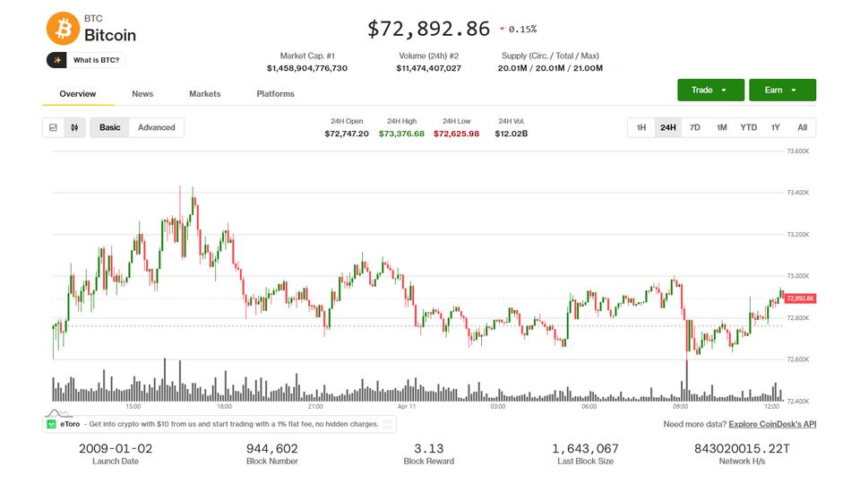
Bitcoin continues to hover just below the $73,000 mark, currently trading at $73,120.12, experiencing a slight decrease of approximately 0.2% within the last 24 hours. This stall in momentum comes as significant geopolitical developments unfold, specifically high-level discussions taking place in Islamabad among U.S. and Iranian officials. Meanwhile, the broader cryptocurrency market remains relatively stable, showing minimal fluctuations across major digital assets.
The past week saw a notable uptick in the market, aided by the announcement of a two-week ceasefire between the U.S. and Iran. This development catalyzed a derivatives short squeeze, which effectively liquidated over $430 million in bearish positions, providing a much-needed boost to investor confidence. In the recent trajectory, the CoinDesk 20 index has demonstrated a modest increase of about 0.12% within the last day. Ethereum, another key player in the space, registered a slight uptick of around 0.1%, while other prominent cryptocurrencies remained steady with similarly small fluctuations.
However, the tenuous nature of the U.S.-Iran ceasefire looms large over market sentiments. Tensions continue to escalate, as Israel has resumed airstrikes against targets in Lebanon. Adding to the unrest, Iran announced plans to implement tolls for ships traversing the vital Strait of Hormuz, inciting criticism from U.S. President Donald Trump, who has been vocal on issues of security and trade in the region.
According to CNN reports, U.S. officials—including Vice President J.D. Vance, special envoy Steve Witkoff, and Jared Kushner—are spearheading the negotiations. Although Kushner holds no formal governmental role, his long-standing ties to Trump make his involvement significant. The Iranian delegation, meanwhile, includes high-ranking officials such as Foreign Minister Abbas Araghchi and Parliament Speaker Mohammad Bagher Ghalibaf. Pakistan is playing a mediator role in these crucial discussions.
As the talks unfold, some maritime traffic has resumed in the Strait of Hormuz after a period of stagnation brought on by intensified U.S. military actions against Iran starting in late February. The re-establishment of shipping routes through this pivotal chokepoint is vital, as it sees a significant portion of the world’s oil supply transit, underscoring the interconnected nature of geopolitical stability and economic markets, including cryptocurrency.
In the shadow of these developments, investors remain watchful, weighing geopolitical risks against market opportunities in a landscape marked by volatility and uncertainty.