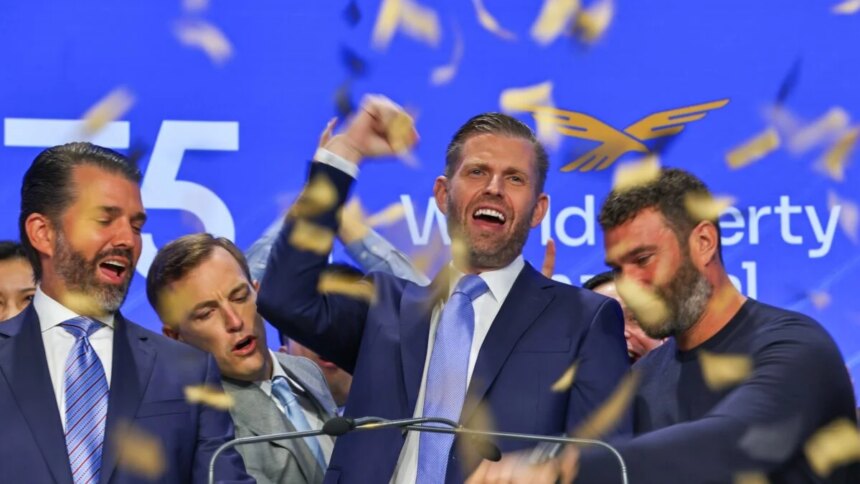
The Trump family’s venture into cryptocurrency, through their World Liberty Financial (WLFI) project, is facing significant backlash over its treasury’s recent financial maneuvers. The project’s treasury reportedly used billions of WLFI governance tokens as collateral to secure stablecoin loans through Dolomite, an affiliated decentralized finance (DeFi) lending platform. This strategy has drawn parallels to the circular borrowing practices that contributed to the demise of the now-infamous crypto exchange FTX in 2022.
According to reports, the treasury wallet of World Liberty Financial has funneled approximately five billion WLFI tokens into Dolomite, resulting in a borrowing amount of about $75 million in stablecoins. This includes $65.4 million of its own USD1 and $10.3 million in USDC. Subsequently, over $40 million of the borrowed amount has reportedly been transferred to Coinbase Prime. This kind of borrowing has raised concerns, as it has pushed Dolomite’s USD1 pool utilization to around 93%, complicating the withdrawal capabilities of other depositors.
The concentration of WLFI collateral within Dolomite is alarming, accounting for roughly 55% of the total value locked in the platform. Experts warn that a decline in WLFI’s token price could precipitate large-scale liquidations, creating bad debt and negatively impacting other users of the platform. The limited market depth for the WLFI token on exchanges amplifies the risk; forced liquidations could lead to a rapid price drop, worsening the collateral shortfall. This situation is reminiscent of Alameda Research’s borrowing practices against FTT tokens on FTX, which used self-referential collateral and ultimately contributed to the exchange’s collapse. However, this occurrence is playing out in full view on the blockchain, allowing for real-time tracking of positions, a transparency that starkly contrasts with the hidden arrangements of FTX.
In defense of their strategy, World Liberty Financial has dismissed the criticism as “FUD” (Fear, Uncertainty, and Doubt). The team characterized itself as an “anchor borrower” committed to generating higher yields for lenders and emphasized that they are “nowhere near liquidation.” They also indicated a willingness to provide additional WLFI tokens as collateral should market conditions become adverse. Despite these assertions, the WLFI token’s value has plummeted nearly 20% since the concerns arose.
On a different note, World Liberty Financial, along with the USD1 stablecoin, has been entwined in corruption allegations stemming from the Trump administration. Recent developments include the SEC’s settlement with Justin Sun for $10 million related to accusations of selling unregistered securities and wash trading. Sun is known to hold significant stakes in both WLFI and the TRUMP memecoin. Democrats from the House Financial Services Committee have suggested that there may be pay-to-play dynamics influencing the handling of these allegations.
Additionally, a UAE-based firm associated with Sheikh Tahnoon bin Zayed Al Nahyan recently secured a $500 million deal for a 49% stake in World Liberty Financial, with $187 million paid in advance to Trump family entities. Eric Trump was involved in signing this agreement, which has been labeled as a politically corrupt arrangement, particularly after the Trump administration lifted prior national-security restrictions on UAE access to Nvidia AI chips.
Compounding these controversies, the White House had previously pardoned Binance founder Changpeng Zhao after his conviction for violations related to the Bank Secrecy Act. This decision has been criticized by former Department of Justice officials as “unprecedented corruption,” especially given Binance’s subsequent $2 billion investment in USD1. In stark contrast, the developers of Samourai Wallet, who faced similar legal issues, received significantly harsher sentences.
Faced with these discrepancies, Democrats are advocating for enhanced ethics safeguards through the pending CLARITY Act, which aims to clarify regulatory frameworks for the U.S. crypto industry. This legislation seeks to prevent officials and their family members from benefiting financially from crypto ventures while shaping regulation. The current status of the CLARITY Act remains uncertain due to varying priorities among stakeholders in the crypto and banking sectors.