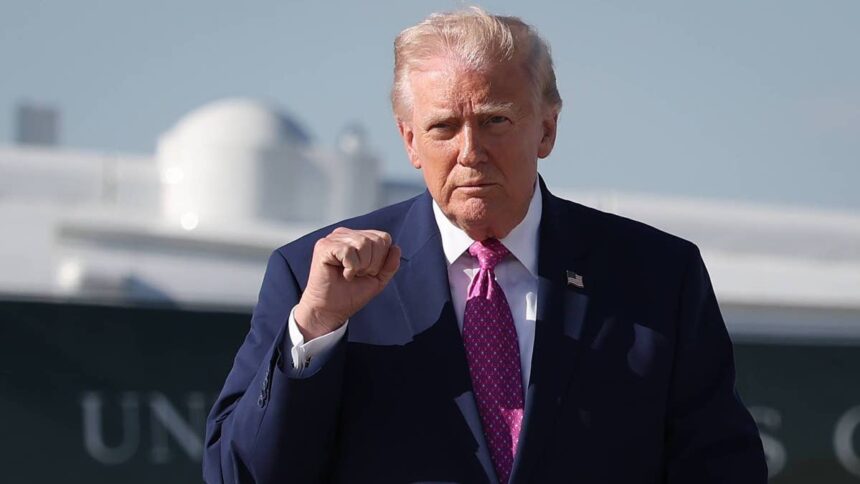
In a historic moment on April 10, former President Donald Trump became the first sitting U.S. president to publicly endorse a stock by its ticker symbol, making headlines with his support for Palantir Technologies. He shared a post on his platform, Truth Social, highlighting the company’s capabilities in warfare technology and directly referencing its ticker, PLTR. Following his endorsement, Palantir’s stock saw an initial increase of about 3%, climbing to approximately $128.
However, the boost was short-lived. By early afternoon, the share price fell back, closing the day down 3.7% and ultimately ending at $128. Prior to Trump’s post, Palantir faced significant market pressures, having already experienced a decline of 14% to 16% over the past five trading days, with a drastic drop of 6% the same day before the endorsement was made. Since the beginning of 2026, the stock has plummeted roughly 24%.
The volatility surrounding Palantir is attributed to broader concerns in the software industry, particularly regarding potential disruptions from artificial intelligence. Prominent short seller Michael Burry, who has publicly criticized Palantir for what he describes as overvaluation, echoed these fears. He claimed that competitors like Anthropic are adversely impacting Palantir’s enterprise market share.
Despite the fleeting rise in stock price following Trump’s tweet, the market sentiment indicates that such political endorsements may not sway the long-term fundamentals of the company. Palantir, which currently trades at around 109 times its forward earnings, significantly exceeds the sector median of approximately 21 times. Insider trading data also shows that $432.9 million worth of shares have been sold by insiders in the last three months with no purchases reported.
Additionally, Palantir experienced a steep decline from its 52-week high of $207.52 in November 2025, reflecting a more than 38% drop. Burry reaffirmed his commitment to short positions against the stock, stating that he considers Palantir to be “wildly overvalued.” He has maintained his short stance since fall 2025 and noted that he would not be selling his positions, which include $50 puts for June 2027 and $100 puts for December 2026.
Market analysts have presented mixed views on the company’s prospects. Wedbush analyst Dan Ives maintained an outperform rating for Palantir, assigning it a target price of $230, while dismissing Burry’s critique as a “fictional narrative.” Ives highlighted Palantir’s 70% year-over-year revenue growth reported for the fourth quarter of 2025 as a sign of strong business momentum.
Palantir’s ties to the U.S. government are extensive, with secured contracts exceeding $900 million in the past year, including substantial deals with the military and other government agencies. Political backing at the presidential level could potentially influence perceptions of these contracts, but it does not fundamentally alter the company’s growth prospects or valuation metrics.
The week’s events underscore the complexities surrounding Palantir as an investment. As a company intertwined with defense, technology, and now political narratives, its stock is subject to diverse pressures that can lead to heightened volatility. Investors are left to consider these varying influences while assessing the company’s future amidst the static backdrop of market sentiment.