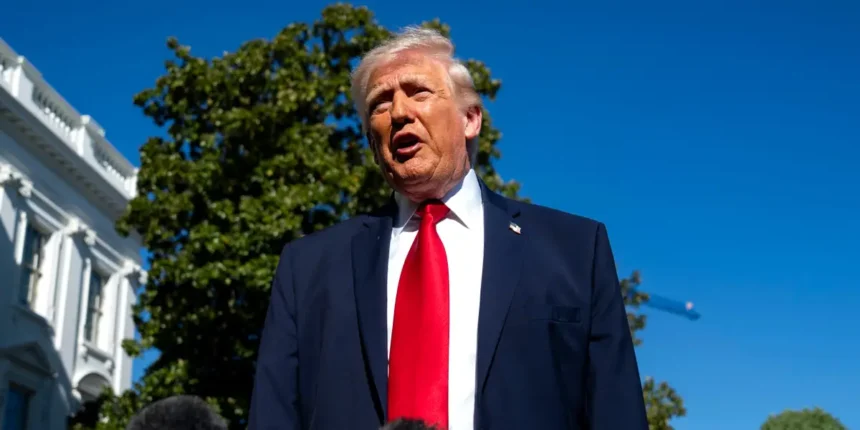
In a recent analysis, BCA Research has suggested that President Donald Trump may reconsider his approach to the ongoing conflict with Iran if market conditions continue to decline. The firm asserts that Trump, who has a well-documented affinity for stock performance, is likely to experience a “breaking point” when the combined drop in the stock and bond markets reaches approximately 12%.
Chief strategist Dhaval Joshi outlined that Trump’s primary concern lies with the implications of the conflict on financial markets rather than the immediate consequences of rising oil prices. He noted that both the stock and bond markets play a significant role in shaping Trump’s responses to geopolitical tensions, as evidenced by prior incidents where the president softened his stance following market stress. Historically, when the composite decline in these markets neared 12-15%, Trump has been known to pivot from harsh rhetoric.
As of the latest updates, the S&P 500 has seen significant losses corresponding with the onset of the conflict with Iran, while the iShares 20+ Year Treasury Bond ETF has experienced a 4% decline from its peak earlier this year. Joshi emphasized that this trend has led to a broader pattern: Trump tends to ease his aggressive positions when faced with deteriorating market conditions—a phenomenon encapsulated in the so-called “TACO Trade,” which stands for “Trump Always Chickens Out.” This pattern was notably highlighted last year during tariff discussions when the president softened his claims to stabilize market reactions.
Despite potential increases in oil prices due to the conflict, Joshi argues that Trump is less concerned with oil shocks, as the U.S. is a net exporter of oil, suggesting a positive economic impact. Instead, the president’s primary worry seems to be the rising inflation that could result from these oil price surges. The increasing costs of gasoline, alongside surging inflation and mortgage rates, are reportedly key issues for Trump’s voter base, and these factors are intricately linked to bond market performance.
Following this line of reasoning, Trump’s administration has been closely monitoring Treasury yields, particularly due to the president’s objective of lowering interest rates in his second term. Treasury Secretary Scott Bessent previously indicated that the administration’s focus includes the crucial 10-year yield, further underscoring the administration’s sensitivity to bond market volatility, especially in light of past experiences with economic sell-offs.
In summary, the intersection of stock market performance and geopolitical strategy appears pivotal for Trump, who remains acutely aware of how financial conditions might influence public sentiment and the broader economy.