Nvidia’s stock is approaching a critical juncture as it has emerged from a period of impressive gains. Analysts are eyeing the $212 mark, the record intraday price reached on October 27, 2025. According to Tom Hayes, the chair of Great Hill Capital, if Nvidia manages to surpass this level, it could potentially attract more buyers and extend its upward trajectory in the weeks ahead.
As of Thursday’s trading session, Nvidia shares had increased by 21% in April alone, marking an extraordinary 11-day winning streak. This remarkable surge can be attributed to multiple factors, notably the bullish outlook from Taiwan Semiconductor Manufacturing Company (TSMC), which highlighted robust demand for AI. Since TSMC manufactures Nvidia’s chips, strong demand signals that Nvidia may be poised for another strong quarter.
Further bolstering Nvidia’s momentum is the favorable news cycle surrounding the company. Recently, it announced a significant expansion beyond its core graphics processing unit (GPU) business with the introduction of Ising, an open family of quantum AI models. These models are already being utilized in various labs and prestigious universities, showcasing Nvidia’s commitment to diversification and innovation.
Additionally, the broader stock market has displayed unexpected resilience in April, buoyed by speculation that the ongoing conflict between the U.S. and Iran might be nearing resolution. The S&P 500 index has shown an 11% increase this month, which has encouraged investors to reallocate funds into high-growth stocks like Nvidia.
Despite the current optimism, some market observers are cautious. BTIG strategist Jonathan Krinsky remarked that while the recent rally could lead some to question the sustainability of this upward momentum, history often shows that “strength begets strength.” Krinsky acknowledged that consolidation may be on the horizon but suggested it might be premature to bet against the current market movement.
The sentiment surrounding Nvidia has shifted dramatically from the first quarter, where the stock faced significant challenges. In that period, Nvidia shares fell by 7.6%, underperforming not only the S&P 500 but also the Dow Jones and Nasdaq indices. Shares dipped below the crucial 200-day moving average, a level that became a point of concern after the stock’s decline in mid-March.
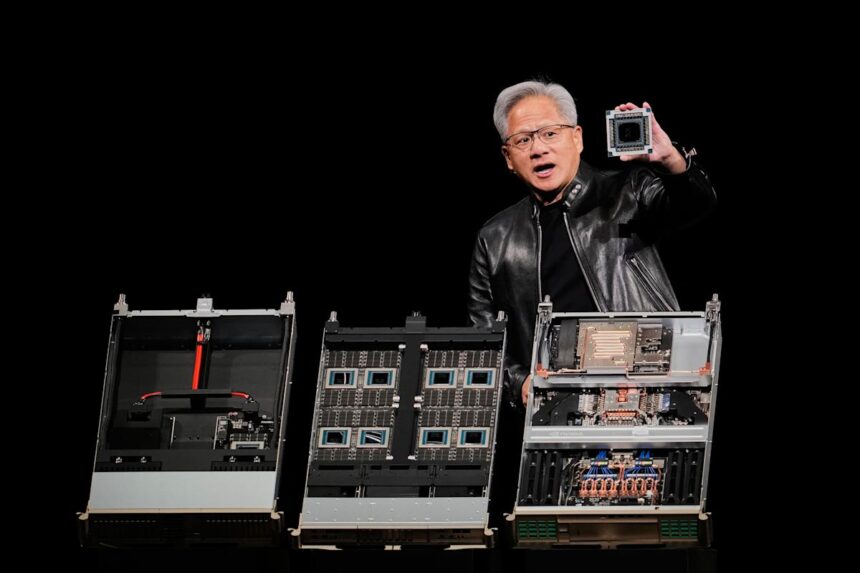
Despite hosting a successful GTC event in early March, where CEO Jensen Huang outlined a potential $1 trillion revenue pipeline through 2027, the stock experienced a “sell the news” reaction. Investors questioned whether much of the anticipated growth was already factored into Nvidia’s high valuation, particularly amid ongoing uncertainties about monetizing its AI inference capabilities.
In summary, as Nvidia’s stock continues its impressive ascent, market players and analysts alike will be closely monitoring its ability to break through the $212 barrier while navigating the complexities of a transforming tech landscape.