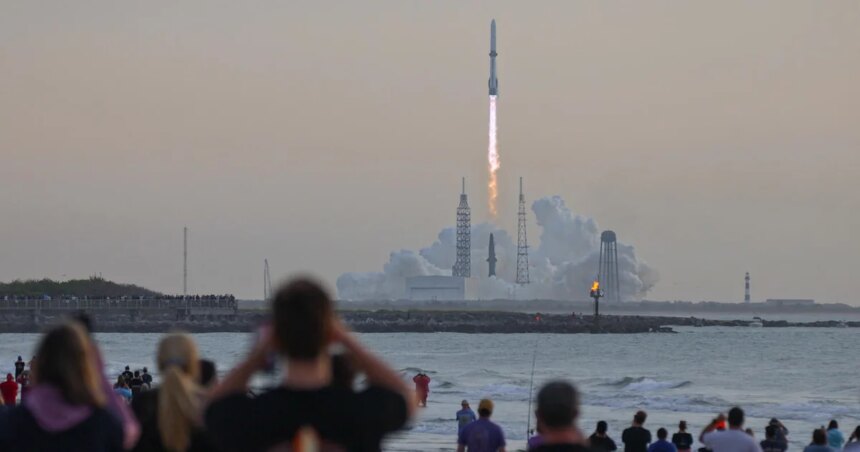
Blue Origin successfully launched its third New Glenn rocket on a Sunday morning from Cape Canaveral Space Force Station, marking a significant milestone by reusing a first stage booster from a previous flight. However, the mission took an unfortunate turn when the rocket’s second stage placed its payload, the BlueBird 7 satellite from AST SpaceMobile, in an unusable orbit.
The launch occurred at 7:25 a.m. ET after a 40-minute countdown hold that raised questions among spectators. Moments later, the powerful seven BE-4 engines roared to life, propelling the rocket skyward with an impressive 3.8 million pounds of thrust. The first stage booster performed flawlessly, detaching and landing as planned on a Blue Origin recovery barge stationed in the Atlantic Ocean.
Despite the first stage’s success, the second stage of the New Glenn rocket, powered by two BE-3 engines, failed to operate as intended, ultimately placing the BlueBird 7 satellite in a lower-than-expected orbit. This discrepancy meant that the satellite’s on-board propulsion system could not compensate for the miscalculation, leading to an anticipated deorbiting.
In a statement following the mission, AST SpaceMobile confirmed that although the satellite was powered on after separation from the launch vehicle, its operational capabilities were compromised due to the incorrect altitude. The exact cost of the satellite has not been disclosed, but it was stated to be fully insured.
The unfortunate setback occurred about two-and-a-half minutes after the first stage successfully landed, as Blue Origin waited for a second engine firing intended to achieve the correct orbit. There were communication delays regarding whether this engine firing took place or was cut short, leaving many questions unanswered.
The BlueBird 7 satellite, featuring a 2,400-square-foot phased array antenna—the largest of its kind in low-Earth orbit—was designed as part of AST SpaceMobile’s initiative to deliver 4G and 5G cellular broadband directly to cell phone users worldwide. The company plans to launch a total of 60 BlueBird satellites in an initial constellation, partnering with multiple launch providers including SpaceX’s Falcon 9 and Indian LVM3 rockets.
Despite the orbiting mishap, AST SpaceMobile remains optimistic about its launch schedule, planning to achieve an orbital launch every one to two months starting in 2026. With agreements in place for future launches, the company aims to have around 45 satellites in orbit by the end of that year.
Meanwhile, Blue Origin is positioning itself to compete directly with SpaceX in satellite deliveries and intends to deploy a fleet of low-earth orbit internet satellites to rival SpaceX’s established Starlink service. The company is also working on developing moon landers to carry out NASA missions.
The performance of the New Glenn rocket is vital to Blue Origin’s broader objectives, including plans for an unpiloted test flight of a Blue Moon lander in the near future and additional launches of Amazon satellite intended to enhance global internet connectivity. However, the next steps will largely depend on the findings from the investigation into the recent launch issues.