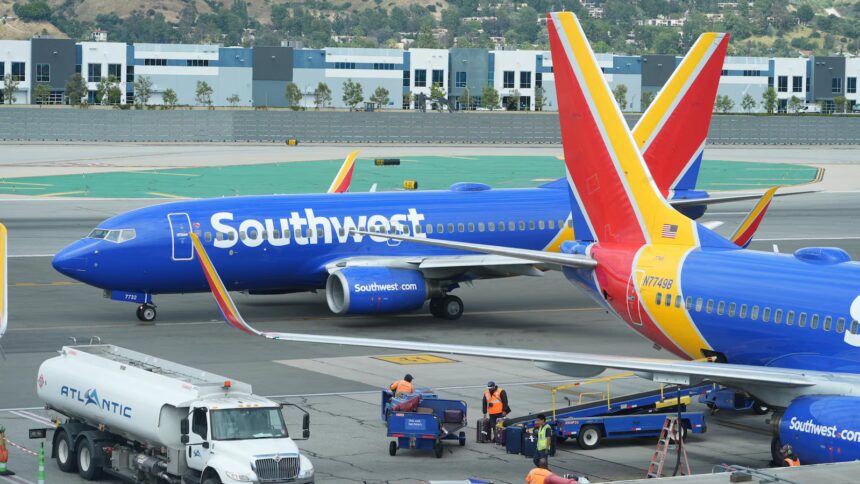
In Nashville, two Southwest Airlines planes were involved in a tense near-collision on Saturday afternoon, necessitating swift evasive maneuvers after an air traffic controller inadvertently directed one jet into the path of the other. This incident occurred amid heightened scrutiny of midair collisions, particularly following a tragic accident in January 2025 when an American Airlines jet collided with an Army Black Hawk helicopter, resulting in the loss of all 67 lives aboard.
While midair incidents are exceptionally rare in commercial aviation—thanks to advanced systems that alert pilots of potential collisions—close calls frequently occur, particularly involving smaller aircraft lacking such technology. The Federal Aviation Administration (FAA) was unable to provide specific statistics regarding the yearly frequency of these occurrences, but it noted that incidents involving small planes are not uncommon.
On the day of the Nashville incident, both Southwest pilots reported receiving alerts from their onboard collision avoidance systems, prompting them to take immediate action. Audio recordings released by LiveATC.net revealed that one plane climbed while the other dove, narrowly avoiding a midair collision. Flight data indicated that the close encounter was preceded by one pilot’s decision to abort landing due to challenging gusty winds at Nashville International Airport, leading him to circle back for another approach.
The air traffic controller had instructed the aborting plane to turn directly into the flight path of another Southwest jet that had just taken off. By the time the controller recognized the potential danger and attempted to guide the departing plane to maintain an altitude below 2,000 feet, the aircraft was already exceeding that elevation. Data from FlightRadar24 suggested that the planes came alarmingly close, with reports indicating a proximity of as little as 500 feet, therefore meeting the official criteria for a near midair collision.
The FAA has launched an investigation into the incident, affirming that the pilot of Southwest flight 507 acted in accordance with the controller’s directions, which inadvertently placed the plane on a collision course. Southwest Airlines spokesperson Lynn Lunsford attributed the situation to the adverse weather conditions and praised the professionalism of the flight crews in responding to the alarms. “Nothing is more important to Southwest than the safety of our customers and employees,” he stated. As the FAA’s investigation continues, further details regarding the exact circumstances of the incident and the distance between the aircraft involved are anticipated.