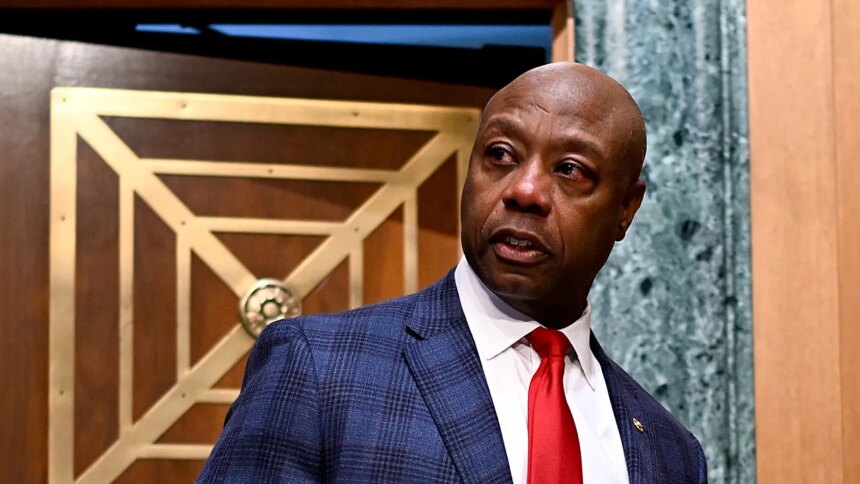
Senate Banking Committee Chairman Tim Scott, R-SC, expressed confidence in Kevin Warsh’s upcoming confirmation as the new chair of the Federal Reserve, despite anticipated opposition from Senate Democrats. Warsh, nominated by former President Donald Trump, is slated to replace outgoing Chairman Jerome Powell. Scott posited that Warsh’s extensive background in economics and familiarity with the Federal Reserve makes him an excellent choice for the role.
In a recent interview, Scott remarked, “I think Kevin is a fantastic person and a very strong pick. I’ve known Kevin for a number of years now. He’s one of my favorites in the world of economics.” He emphasized the expectation of a robust support base among Republicans, although he acknowledged that some Democrats may linger on discussions concerning Warsh’s financial disclosures, which have reportedly delayed the confirmation hearing.
The Senate hearing is scheduled for Tuesday, where Warsh will face questioning from Scott’s committee. Scott noted that Democratic members may focus more on Warsh’s financial history rather than his qualifications and understanding of complex economic issues. “You’ll see a lot of hand-wringing around disclosures as opposed to hand-wringing around economic knowledge,” he stated.
The backdrop to Warsh’s nomination involves ongoing tensions between Trump and Powell regarding interest rates and Federal Reserve leadership. Allegations have emerged surrounding Powell’s testimony about a significant renovation project at the Fed headquarters, which is being investigated by Judge Jeanine Pirro, appointed by Trump. Powell has rebuffed claims that he misled Congress, asserting that his actions have always been in alignment with transparency.
Scott further articulated a belief that Warsh would maintain the Federal Reserve’s independence more effectively than Powell during his tenure, criticizing Powell’s perceived political engagement. “I think Powell did not know the definition of transitory […] Kevin understands the importance of the independence of the Fed,” Scott explained. He raised concerns over Powell’s involvement in political matters, particularly relating to the current administration’s climate agenda, which he believes should be left to Congress.
Warsh, who began his career at the Federal Reserve at a young age, holds significant credentials including a law degree from Harvard and experience in economic policy under former President George W. Bush. Scott is optimistic about securing sufficient Republican votes in support of Warsh during the Senate’s deliberation process. He noted that the Democrats’ reluctance to support Trump plays a significant role in the confirmation dynamics.
Following the committee hearing, the Senate will vote on Warsh’s nomination, requiring only a simple majority for confirmation. Powell’s term concludes on May 15, positioning Warsh to potentially assume the role around that date. Scott lamented that, despite the merits of Warsh’s candidacy, partisan politics may hinder bipartisan support: “Democrats are now afraid of supporting President Trump, even if it’s in the best interest of the country, which is quite unfortunate.”