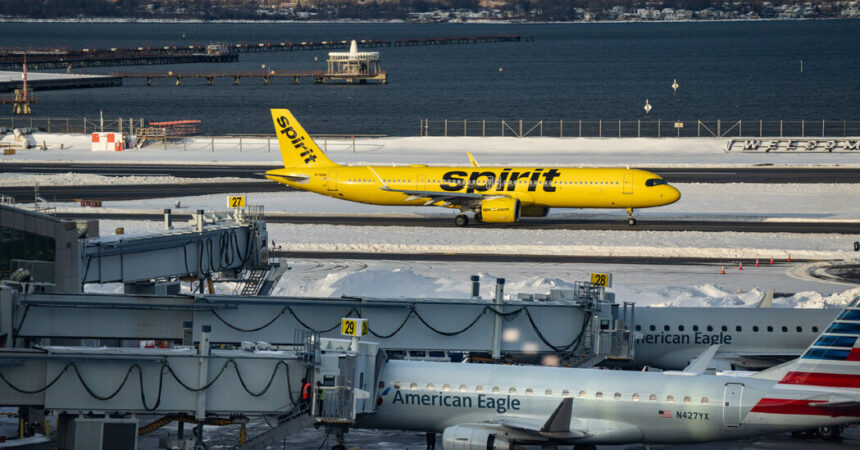
In a recent interview with CNBC, former President Donald Trump expressed his opposition to a potential merger between United Airlines and American Airlines, while simultaneously signaling his openness to other airline consolidations, particularly those that could aid struggling carriers like Spirit Airlines.
Trump voiced his support for potential mergers that aim to save at-risk airlines, particularly noting Spirit Airlines, which is currently facing significant financial challenges and has entered its second bankruptcy in just two years. The low-cost carrier has struggled with intense competition, escalating operational costs, and delays stemming from a failed acquisition attempt by JetBlue Airways. Furthermore, recent surges in jet fuel prices, exacerbated by geopolitical tensions, have compounded Spirit’s difficulties.
During the interview, Trump highlighted the importance of preserving jobs, stating, “It’s 14,000 jobs and maybe the federal government should help that one out.” His remarks suggest a willingness to explore federal assistance to help stabilize Spirit Airlines in the face of its ongoing troubles.
However, the specifics of how the Trump administration might provide such support remain unclear. Historically, the U.S. government has extended financial aid to airlines during significant crises, including after the September 11 attacks and during the COVID-19 pandemic. These instances were rooted in formal legislation, raising questions about the viability of any future assistance for Spirit.
The complexities surrounding Spirit’s bankruptcy further complicate potential government intervention, particularly regarding the feasibility of the government acquiring a stake in the airline. Any move to financially assist Spirit could set a precedent encouraging other struggling airlines to seek similar relief, particularly as the industry grapples with the impacts of rising costs stemming from international conflicts.
In contrast to his first term, during which he often maintained a more hands-off approach regarding corporate mergers and governmental investment, Trump’s second term has seen a notable shift. He has displayed a greater readiness to involve the government in corporate matters, as evidenced by recent actions that include the federal government acquiring a 10 percent stake in Intel and a “golden share” in U.S. Steel.
Yet, analysts caution that while government funds might provide temporary relief, they may not address the underlying structural issues that Spirit faces. Trump’s disapproval of the proposed United-American merger coincided with recent discussions held between United’s CEO Scott Kirby and Trump earlier this year. This merger, if approved, would significantly alter the landscape of the U.S. airline industry, potentially creating the largest airline in the world.
Both United Airlines and American Airlines have publicly distanced themselves from the merger talks, with American explicitly stating it is not pursuing negotiations with United. As the airline industry continues to navigate through turbulent times, Trump’s statements reflect both an acknowledgment of the industry’s challenges and an invitation for strategic partnerships that could preserve jobs and infrastructure.