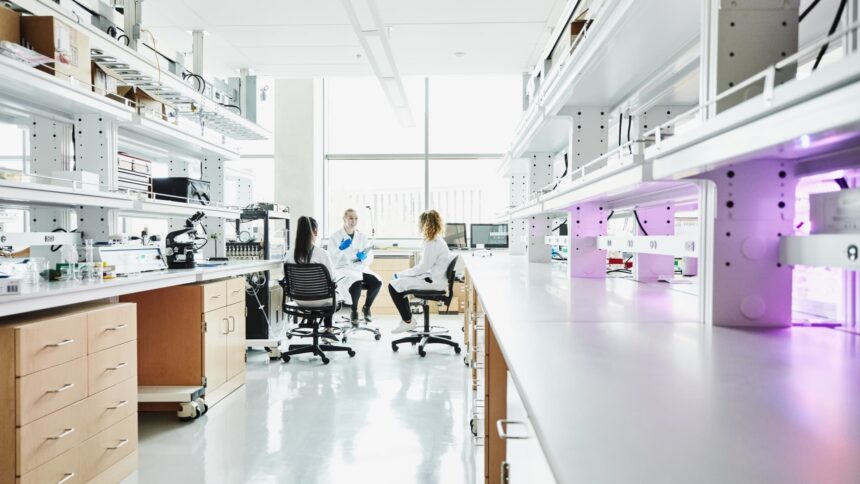
The life sciences sector is currently navigating significant shifts, primarily stemming from a sharp decline in demand last year when the National Institutes of Health (NIH) had to cancel billions in research grants due to federal budget cuts. As a result, the tenant landscape for life science laboratories, particularly in biotechnology and biopharma, is undergoing considerable upheaval.
Recent data from JLL indicates that among the ten largest life sciences markets, the aggregate vacancy rate has increased to 27.4% in the first quarter of this year, up from 25.7% during the same timeframe in 2025. Prominent markets like Boston and the Bay Area have experienced vacancy rates exceeding 30%. However, there are signs of stabilization in the sector. A report from CBRE highlighted that venture capital investments in life sciences during the latter half of 2025 reached their highest levels since 2022, though the volume of construction underway has plummeted to levels not seen since 2017.
JLL’s outlook suggests a gradual stabilization of the market driven not by a significant rebound in demand but rather by supply rationalization. The forecast predicts availability rates will decline to around 20% by 2030, contingent on continued underwhelming absorption and substantial supply exits through distress sales and adaptive reuse projects. Travis McCready, who leads industry leasing advisory at JLL, described the current oversupply scenario as a result of extraordinary construction levels and a fundamental transformation in how life sciences companies utilize real estate.
This transition is partly attributable to advancements in technology, including artificial intelligence (AI) and robotics, which have fundamentally altered the operational landscape for biotech firms. McCready emphasized that the sector must adapt to these new technological realities, indicating that approximately 19 million square feet of available lab space will be converted to alternative uses by 2030. Those companies and markets that successfully pivot amid these changes are expected to emerge more resilient and competitive.
Architectural firm Gensler has been examining the impact of automation and robotics on laboratory operations through a comprehensive year-long research initiative. Ryley Poblete, who oversees Gensler’s global sciences practice, noted that this transformation is changing the way laboratories are designed and function, particularly in “wet bench” areas where traditional experiments are conducted. Many of these processes are now being supplanted by AI and automated systems, prompting a reevaluation of facility requirements.
The study identifies that many existing laboratory spaces classified as “Class A” are actually falling short of quality standards. As the real estate landscape for life sciences evolves, discussions are increasingly focusing on which types of lab spaces will thrive moving forward. Larger biotech and chemical companies are rethinking their infrastructures, either validating existing facilities’ potential or exploring consolidation and new construction strategies.
Gensler is currently assessing older laboratory environments for compatibility with the increasing power and air requirements stemming from AI systems, as well as the feasibility of incorporating robotics into these spaces. This can involve retrofitting labs to accommodate machine-heavy operations while ensuring conducive environments for traditional scientific processes that require concentration and quiet.
Moreover, the collaborative nature of scientific work is changing. Researchers are now more integrated with AI specialists, engineers, and process designers, marking a significant cultural shift within the industry. The historical narrative of the solitary “hero scientist” is being replaced with a more interdisciplinary approach. Poblete pointed to Genentech’s ongoing multi-year $4 billion expansion of its headquarters in Basel, Switzerland, as a model of this new collaborative ethos. This development aims to modernize research facilities and consolidate research and development functions—an endeavor emblematic of the life sciences sector’s current evolution.