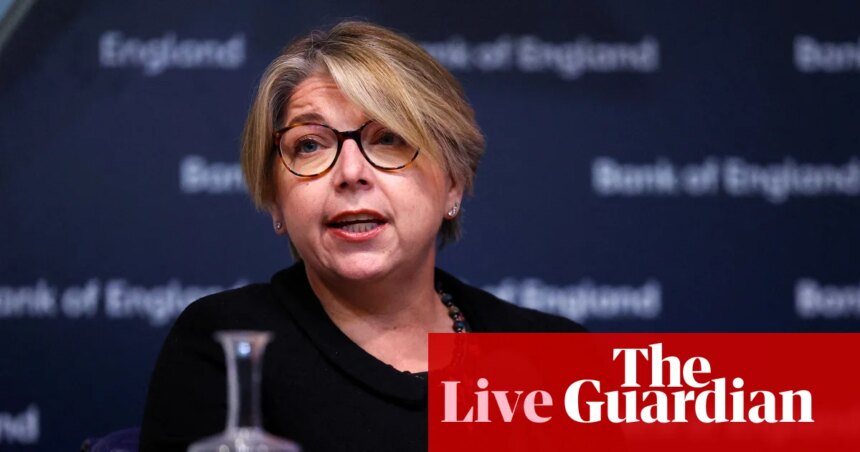
Stock markets are currently experiencing significant volatility, with concerns over high valuations and global economic risks leading to increased uncertainty. Sarah Breeden, the Bank of England’s deputy governor, has voiced her apprehensions about the stock market’s current state, stating that asset prices have reached all-time highs despite the persistent risks posed by various global tensions, including the ongoing conflict in the Middle East.
In an interview with the BBC, Breeden emphasized, “There’s a lot of risk out there and yet asset prices are at all-time highs. We expect there will be an adjustment at some point.” This assessment aligns with recent discussions from the Bank’s financial policy committee, which highlighted vulnerabilities tied to elevated valuations in the artificial intelligence sector, disruptions from technological advancements, and uncertainties in the private credit market.
Breeden cautioned that the fear of multiple risks unfolding simultaneously could lead to significant economic repercussions. Changes in market confidence, particularly with regard to AI valuations and private credit stability, are of particular concern. However, she clarified that while a market correction is not predictable in the short term, preparations are being made to ensure the resilience of the UK financial system in the face of potential downturns. “What we are watching for: is how might those prices fall? Will there be a sharp adjustment downwards? And if there is such an adjustment, how will that affect the economy?” she posed, indicating a cautious outlook.
As trading commenced, the London stock market saw a decline, with the FTSE 100 index dropping 48 points, or 0.46%, to settle at 10,408 points. Investor sentiment appears to be affected by the stagnant progress in resolving the Iran conflict and the implications of Breeden’s warning.
Conversely, Japan’s Nikkei share index reached new heights, closing at a record high, buoyed by strong earnings from the technology sector, overshadowing concerns related to the Middle East.
On the corporate front, Mondi, a packaging company, announced plans to increase prices in response to rising costs driven by the conflict. The Weybridge-based group revealed it would be implementing significant cost-cutting measures, including the closure of several factories and the reduction of its workforce by 450 jobs across Europe. These changes come as the company faces ongoing challenges in a tough trading environment, exacerbated by soaring energy costs linked to the conflict.
In a broader economic context, retail sales in the UK reportedly experienced a boost in March, influenced by increased demand for fuel as prices climbed due to geopolitical tensions. According to the Office for National Statistics, overall retail sales rose by 0.7% last month, with motor fuel sales significantly contributing to this figure.
The financial landscape was further complicated by comments from U.S. President Donald Trump, who threatened to impose tariffs on the UK unless the government retracts its digital services tax on American tech firms. This tax, introduced in 2020, has been a contentious point, with Trump indicating a willingness to take aggressive trade measures in response.
Overall, the financial market’s current trajectory is marked by an interplay of high valuations, geopolitical unrest, and the complexities of domestic and international economic policies, suggesting a tumultuous path ahead for investors and policymakers alike.