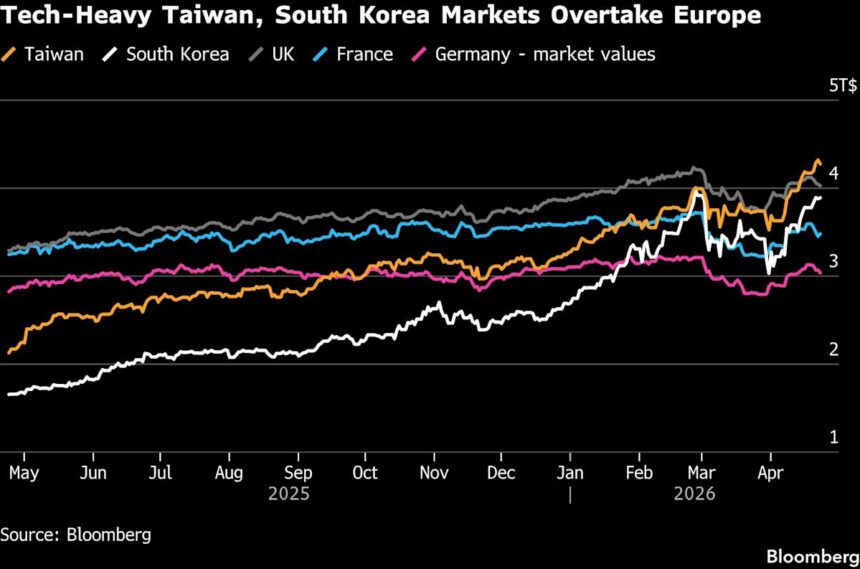
The rise of artificial intelligence (AI) has significantly shifted dynamics within global equity markets, particularly benefiting Taiwan and South Korea. These nations have rapidly ascended the ranks, overtaking several European countries in market valuation.
Taiwan’s stock market recently reached nearly $4.3 trillion, surpassing the United Kingdom, Europe’s largest market. South Korea, with a market value currently sitting just $140 billion shy of the UK, is also close to a notable breakthrough. In the past seven months, these tech-centric Asian markets have outperformed Germany and France, reflecting a seismic shift in investor sentiment.
The primary driver behind this advancement is the remarkable growth of three critical companies central to AI hardware production: Taiwan Semiconductor Manufacturing Co. (TSMC), Samsung Electronics Co., and SK Hynix Inc. These firms are key players in the semiconductor industry, which has emerged as essential to modern economic activity. The increasing investments in AI are driving up the stock values of these companies, showcasing the oligopolistic nature of advanced semiconductor manufacturing.
Despite rising tensions from international trade tariffs and geopolitical conflicts, such as the ongoing situation in Iran, the Asian region has firmly established its economic significance. Notably, Taiwan reported a 16-year high in March export orders, propelled by a surge in chip shipments. Similarly, South Korea has seen exports grow over 40% for two consecutive months, again driven by vibrant demand for semiconductors.
The stock performance of TSMC, which has soared more than 40% this year, and the incredible surges of over 80% for both Samsung and SK Hynix accentuate this trend. TSMC’s current market capitalization stands at approximately $1.8 trillion, while Samsung and SK Hynix together are valued at about $1.5 trillion. In contrast, Europe’s largest chip-equipment manufacturer, ASML Holding NV, is smaller than any of these Asian giants, and the collective value of all technology firms in the Stoxx Europe 600 Index is roughly $1.4 trillion.
There’s a clear divergence between sectors, particularly in relation to technology stocks. The concentration of technology firms in these Asian markets has led to a more pronounced impact of AI-related investments compared to Europe, where financial institutions dominate the stock landscape.
However, despite the impressive market values of the Asian chip manufacturers, their economies still lag behind Europe’s major nations. The International Monetary Fund estimates South Korea’s GDP at approximately $1.9 trillion this year, while Taiwan sits at around $977 billion. In contrast, Germany, the UK, and France each forecast GDPs exceeding $3 trillion.
Investors have raised concerns regarding the heavy reliance on tech stocks, especially considering that Samsung and SK Hynix represent about 42% of South Korea’s Kospi index, and a similar proportion is attributed to TSMC within Taiwan’s Taiex. Nonetheless, the AI sector is expanding, encompassing a broader range of hardware and applications beyond just these market leaders. This diversification is evidenced by TSMC’s declining index weighting as other companies like MediaTek Inc. and Delta Electronics Inc. gain prominence.
As Taiwan’s market value continues to grow, it is approaching that of Canada, which has benefited from gains in resource-related equities. In contrast, India’s stock market is currently facing challenges due to rising energy prices and weaknesses in its banking and IT sectors.
Europe’s relatively slower growth trajectory in market capitalization is largely attributed to its focus on more mature sectors, lacking the rapid development seen in the tech markets of North Asia. Investment professionals assert that Korea and Taiwan hold sustainable advantages in innovation, talent, and manufacturing, making them attractive destinations for global capital.
Widespread retail support is also revitalizing Asian markets, with an increase in participation from individual investors in both South Korea and Taiwan, known as “ants” for their collaborative trading strategies. This influx of domestic capital further reinforces the bullish sentiment surrounding these economies.
Market analysts are increasingly optimistic about the long-term sustainability of gains in the Taiwanese and South Korean markets, indicating a transformative moment in global equity trends as AI continues to evolve and integrate into everyday life.