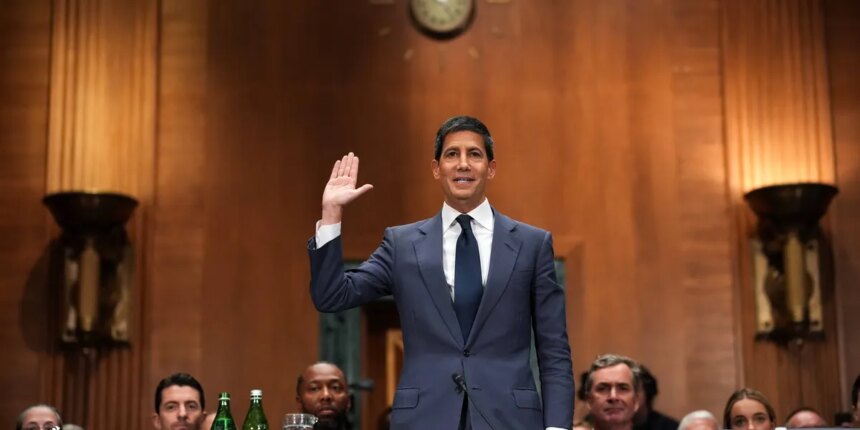
In a significant move late Friday night, Republicans on the Senate Banking Committee have set a date for a vote to advance Kevin Warsh, President Donald Trump’s nominee, to lead the Federal Reserve. This decision comes shortly after the Justice Department announced it was dropping its criminal investigation into Jerome Powell, the current Fed chair. The vote is scheduled for April 29, positioning Warsh for potential confirmation by the end of Powell’s term on May 15.
Senator Elizabeth Warren (D-Mass.), the leading Democrat on the banking panel, condemned the timing of the Justice Department’s announcement. She expressed concerns that the Republican majority might be attempting to mislead the American public, arguing that the department’s decision to halt its investigation into Powell was a strategic move to facilitate Warsh’s confirmation. Warren noted that the investigation into Powell, which has faced significant public criticism, could be revived at any time, as it has now been delegated to the inspector general.
The inquiry into the Federal Reserve’s building renovations was widely deemed politically motivated and failed to uncover any evidence of wrongdoing. Jerome Powell, whom Trump nominated to the Fed in 2017, has been under scrutiny for not aligning with the president’s desired monetary policies. Warren further criticized Warsh, stating that Republicans should be wary of supporting his nomination if they genuinely value the independence of the Federal Reserve. During his confirmation hearing, she characterized Warsh as a mere “sock puppet” for Trump.
Interestingly, while the DOJ investigation was active, Senator Thom Tillis (R-NC) had put a hold on Warsh’s confirmation. Following the DOJ’s announcement, it remains unclear if Tillis is satisfied with the resolution of the investigation into Powell.
Critics, including Warren, have expressed apprehensions regarding Warsh’s potential to yield to Trump’s influence if confirmed as Fed chair. Warsh has faced scrutiny for his inability to acknowledge the legitimacy of the 2020 election results, a stance that has led economists like Justin Wolfers to label him as lacking independence. Wolfers stated that Warsh’s refusal to acknowledge straightforward facts during his hearing raises questions about his capacity for independent judgment.
Moreover, observers have voiced concerns about the opacity surrounding Warsh’s financial disclosures. His recent filings indicate ownership of assets between approximately $135 million and $226 million, yet specific details regarding over $100 million in holdings remain undisclosed due to confidentiality agreements. Warren remarked that after discussing Warsh with a White House briefer concerning the FBI investigation, she learned there had been no inquiry into Warsh’s financial portfolio, including any associations linked to the publicly available Epstein files, nor into potential undisclosed connections.
As the vote approaches, the debate surrounding Warsh’s nomination is intensifying, reflecting broader concerns about the future direction of the Federal Reserve and its independence amid political pressures.