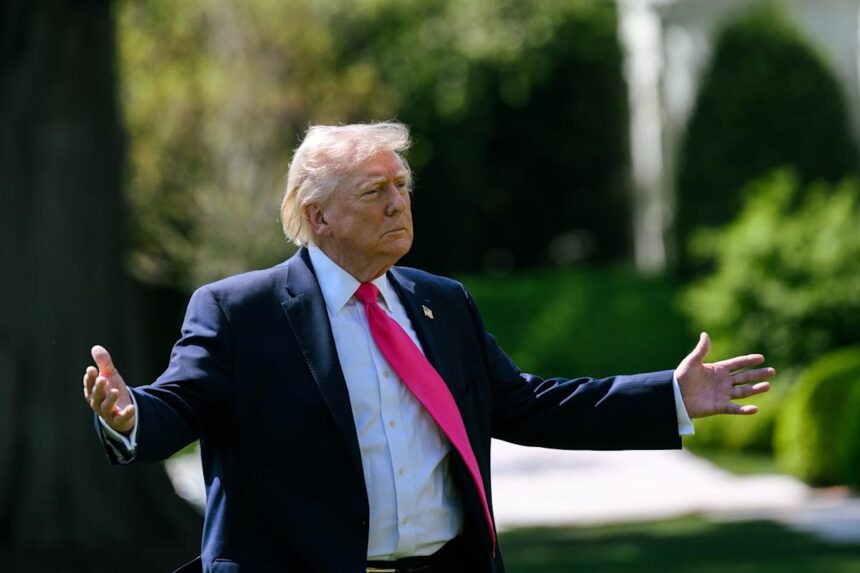
From a statistical perspective, Wall Street has enjoyed a significant boost during Donald Trump’s presidency. Notably, the annualized returns of the Dow Jones Industrial Average, S&P 500, and Nasdaq Composite have outperformed historical averages. Under Trump’s initial term, the Dow, S&P 500, and Nasdaq Composite surged by 57%, 70%, and an impressive 142%, respectively. Currently, in the president’s second, non-consecutive term, these major indexes have risen by 14%, 19%, and 24%, as of April 20.
Multiple factors contribute to this rally, including burgeoning interest in artificial intelligence (AI) and unprecedented share buybacks in the S&P 500. However, potential drawbacks threaten to derail this bullish trend. Although investors have previously been wary of Trump’s tariff and trade policies, a more pressing concern looms on the horizon, anticipated to materialize on May 15.
Since Trump’s inauguration on January 20, 2025, tariffs have dominated Wall Street discussions. In April of the previous year, he introduced a sweeping 10% global tariff along with elevated reciprocal tariffs on numerous countries perceived to have unfavorable trade balances with the United States. These tariffs underwent multiple modifications before the U.S. Supreme Court invalidated them in February 2026, determining that the International Emergency Economic Powers Act did not authorize such actions. Consequently, the Trump administration imposed a temporary 10% global tariff for 150 days using alternative policy justifications.
The president’s strategy with these tariffs aims to incentivize domestic manufacturing for goods destined for the U.S. market. However, a December 2024 report from four economists at the New York Federal Reserve, published in Liberty Street Economics, revealed troubling ramifications of the tariffs for businesses and the broader stock market. This analysis of the tariffs imposed on China from 2018 to 2019 indicated that affected businesses generally witnessed declines in employment, productivity, sales, and profits between 2019 and 2021. Notably, input tariffs—which are levied on imported goods necessary for product manufacturing—often ultimately elevated production costs, thereby hindering U.S. goods’ competitiveness in price relative to international products.
However, the focus may soon shift from tariffs to an even graver concern. May 15 will witness Jerome Powell’s departure from his role as Federal Reserve Chair. The conclusion of his tenure has been anticipated for some time, especially given Trump’s vocal criticism of Powell and the Federal Open Market Committee (FOMC) throughout his second term. Trump has argued for aggressive reductions in interest rates to 1% or less, a decrease that could ease the burden of America’s national debt, which exceeds $39 trillion. In contrast, Powell has maintained that the FOMC’s monetary policy decisions will rely heavily on economic data rather than political input.
On January 30, Trump nominated Kevin Warsh as Powell’s successor. Warsh, who has previously served on the Board of Governors of the Federal Reserve and has participated in decision-making during significant economic crises, brings experience to the table. Yet, he may pose a challenge to the favorable conditions fueling the ongoing stock market rally.
Though Trump may seek a dovish replacement for Powell, Warsh’s history indicates a more hawkish approach. His voting record suggests a preference for higher interest rates aimed at curbing inflation, which may place him at odds with Wall Street’s hopes for continued low rates. Recent inflation trends have shown an uptick, with the U.S. Bureau of Labor Statistics reporting year-over-year inflation rates increasing from 2.4% in February to 3.3% in March, and a forecasted additional rise in April.
Warsh has also criticized the Federal Reserve’s expansive balance sheet post-Great Recession, which ballooned from $900 billion to nearly $9 trillion. His preference for reducing this balance sheet by selling off assets, including long-term Treasuries and mortgage-backed securities, could add further pressure to already rising bond yields, consequently increasing borrowing costs. This situation could be detrimental for a high-priced stock market that relies heavily on low-interest rates to foster innovation and drive growth in areas like AI.
In summary, while tariffs have historically been cited as a significant risk to the Trump bull market, it appears that the potential policies of incoming Fed Chair Kevin Warsh may pose an even greater threat, particularly with the anticipated increase in interest rates and the management of inflation. Investors may want to proceed with caution as the economic landscape evolves.