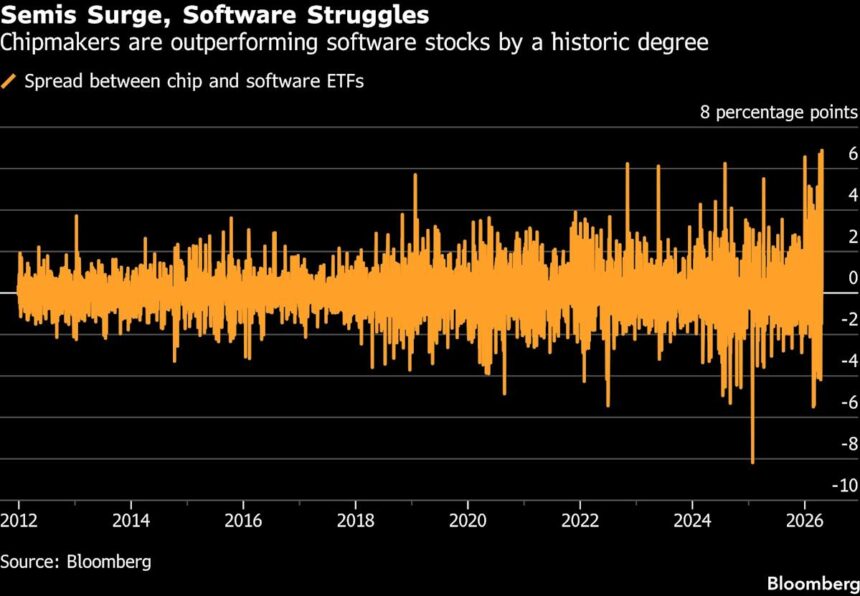
In a year marked by volatility, the technology investment landscape has witnessed a significant split between two key sectors: semiconductors and software. This divide has become increasingly pronounced as 2026 progresses, with a prevailing consensus that a new market reality is emerging.
Kevin Shea, a senior equity strategist at BNY Wealth, highlights a shift in market dynamics, noting that while semiconductor companies continue to see their growth potential and profit margins re-evaluated upwards, software firms are facing downward adjustments in the same metrics. This stark contrast is primarily driven by the escalating investments in artificial intelligence (AI). Semiconductor manufacturers benefit from burgeoning demand for AI-driven technologies, whereas software providers are grappling with the competitive pressures these innovations introduce.
The figures tell a compelling story: the VanEck Semiconductor ETF (SMH), valued at $58 billion, has surged almost 400% since the beginning of the year, including a remarkable 32% increase just this month. In stark contrast, the iShares Expanded Tech Software ETF (IGV), valued at $11.5 billion, recently experienced its worst quarterly performance since the 2008 financial crisis, with a year-to-date decline of 19%.
Last week exemplified this trend, as the SMH soared by 9.1% while the IGV remained flat. On Thursday alone, the semiconductor ETF climbed by 1.1%, contrasting sharply with a 5.8% drop in the software fund—marking the widest daily performance gap recorded since 2011.
However, this trajectory faced potential interruption following a Wall Street Journal report indicating that OpenAI had not met certain targets related to sales and user growth, leading to declines in AI-related stocks, including major chipmakers like Advanced Micro Devices, Broadcom, and Intel, which each fell more than 2.5%.
Earnings reports from key players in both sectors further reinforced the divergence. Texas Instruments provided an optimistic sales forecast, buoyed by the surge in AI-driven demand for data center infrastructure, resulting in a 19% spike in its stock. Intel’s impressive results led to a phenomenal 24% rise, marking its best daily performance since 1987.
Conversely, the software sector faced negative sentiment following dismal earnings from ServiceNow, which dropped 18% after revealing results that raised concerns about AI’s impact on its business model. International Business Machines Corp. also contributed to this caution with underwhelming software performance.
The differing fortune of these sectors has left some investors questioning the sustainability of this divergence. Analysts from Wall Street express concerns over whether the software selloff has been harsh and indiscriminate, while at the same time remarking on the semiconductor rally’s similarities to the dot-com boom era. The Philadelphia Stock Exchange Semiconductor Index achieved an 18-session winning streak, a record that hasn’t been seen previously, climbing by 47% during that period. Despite this impressive rise, some experts suggest that it is approaching unsustainable levels.
The semiconductor index currently trades at 23 times forward earnings, above its ten-year average of 19, yet remains in line with the overall market evaluations, such as the Nasdaq 100 and S&P 500. Strong fundamentals underpin the surge in chip stocks, with projections for a 35% earnings growth for semiconductor firms by 2027, reflecting a significant increase from earlier estimates.
In contrast, software companies are expected to experience much slower earnings growth moving forward, raising concerns among investors about the future of the sector.
As the narrative evolves, experts predict that continued investment in AI and semiconductor technology will likely lead to heightened valuations for chip manufacturers, while a recovery in software appears uncertain. This trend has cultivated a “self-fulfilling” mindset among investors, with many focusing solely on semiconductors as the more promising avenue for returns.
In additional news, OpenAI’s struggles with meeting its ambitious goals have contributed to rising scrutiny around AI investments, while regulatory pressures have led companies like Meta Platforms to reconsider significant acquisitions. The landscape remains dynamic, with ongoing earnings reports set to shape the future trajectory of both sectors in the coming months.