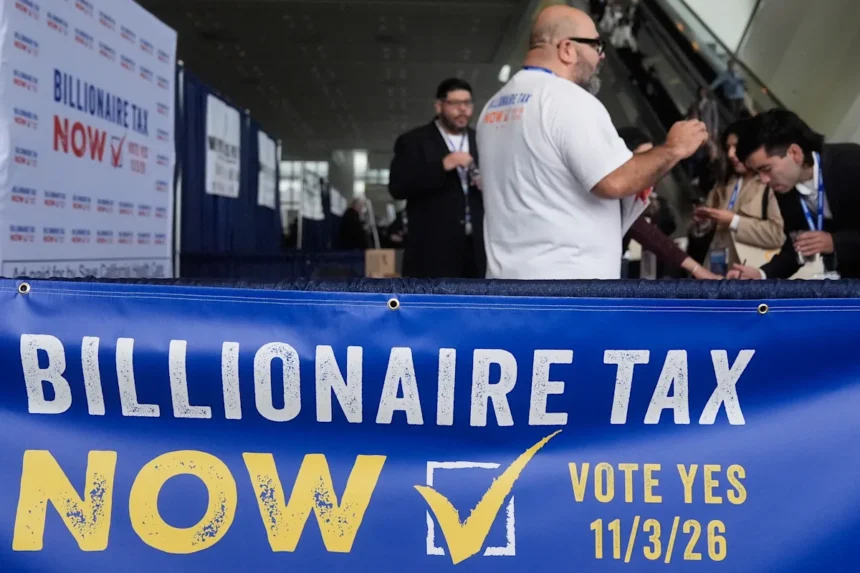
Supporters of a proposed tax targeting California’s billionaires claim they have successfully gathered sufficient signatures to place the initiative before voters in the upcoming fall election. The initiative, primarily championed by the Service Employees International Union-United Healthcare Workers West (SEIU-UHW), aims to impose a one-time 5% tax on the net worth of billionaire residents. Proponents argue that this tax is necessary to avert hospital and clinic closures, safeguard healthcare employment, and finance K-14 public education as well as food assistance programs in the state.
As of now, more than 1.5 million signatures have been submitted to election officials, with a deadline of June 24 for validating the necessary 875,000 registered voter signatures to secure a spot on the ballot. However, the initiative faces potential competition from another measure called the “Transparency Act,” which seeks to reduce government waste and enhance transparency in spending. If both measures reach the ballot and the Transparency Act garners more support, it could jeopardize the billionaire tax initiative.
The proposed billionaire tax would specifically target individuals with primary residences in California as of January 1, 2026, and is estimated to affect approximately 255 billionaires. Notably, several high-profile entrepreneurs, like Google co-founders Larry Page and Sergey Brin, have reportedly relocated out of state since the tax proposal became known, which may reduce the number of eligible taxpayers further.
Unlike traditional income taxes, the billionaire tax focuses on assets, encompassing items such as equity stakes in companies rather than income earned. For instance, estimates suggest that Tony Xu, the founder of DoorDash, could face a tax bill of around $4.17 billion, while Jensen Huang of Nvidia may be liable for approximately $8.5 billion. Huang has publicly expressed his willingness to comply with the tax.
The SEIU-UHW, which has advocated for this tax, argues it is crucial to sustain healthcare staffing levels and services in light of projected federal funding shortfalls that could amount to nearly $100 billion over the next five years due to the passage of certain legislation.
Calculating the tax would involve assessing the assets over $1 billion held by taxpayers and trusts, applying the tax to various asset classes such as businesses and securities, while excluding real property and specific retirement accounts. The initiative’s sponsors estimate that it could generate around $100 billion, with funds allocated toward maintaining hospitals, healthcare jobs, K-14 education, and food assistance programs in California.
Supporters, including the Institute on Taxation and Economic Policy (ITEP), argue that the billionaire tax offsets inequities created by existing tax laws that disproportionately benefit the ultra-wealthy. They contend that many billionaires can evade income taxes by accumulating wealth without selling assets, and this tax would correct that imbalance.
On the other hand, critics raise concerns regarding the design and implications of the proposed tax. The Tax Foundation warns that poorly drafted provisions could unintentionally result in a significantly higher tax burden, leading to forced sales of stocks by company founders, thus affecting stock prices and, consequently, the retirement savings of many Americans. Moreover, the Hoover Institution has predicted that the state could suffer a financial setback of up to $25 billion due to potential billionaire relocations, with actual tax revenue falling short of the projected figures.
In the broader context, discussions around wealth taxes at the federal level have also gained traction, particularly with proposals from politicians like Senator Bernie Sanders. His latest initiative proposes a 5% annual tax on the nation’s billionaires, which could raise an estimated $4.4 trillion over the next decade. However, no formal legislative actions have been taken yet on this proposal.