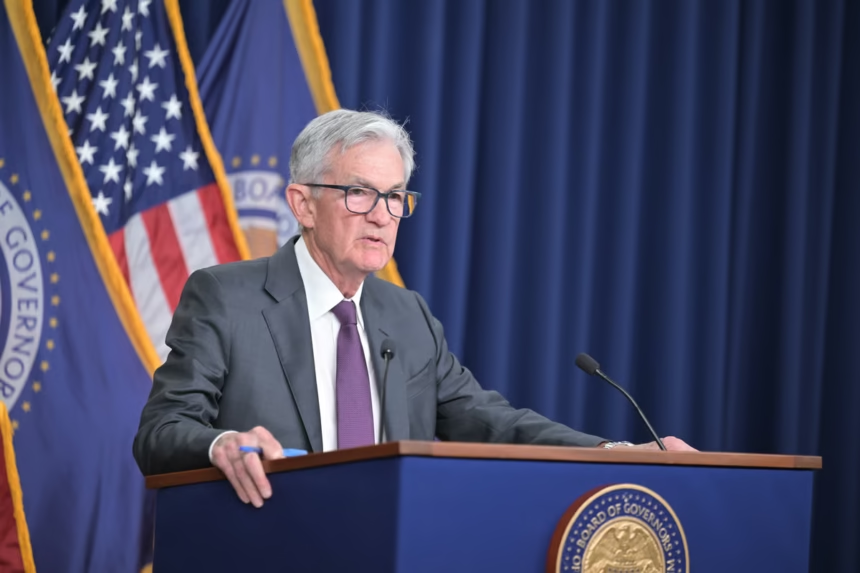
In January, President Trump nominated Kevin Warsh as a potential successor to Federal Reserve Chairman Jerome Powell, whose term is set to end in May. This development has raised concerns among investors, as Trump’s preference for low interest rates might motivate a politically influenced Fed, potentially jeopardizing long-term economic stability.
In a December social media post, Trump articulated his desire for a Fed chairperson who would reduce interest rates if the market performed well, stating, “I want my new Fed chairman to lower interest rates if the market is doing well, not destroy the market for no reason whatsoever. Anybody that disagrees with me will never be the Fed chairman!” This message reflects the president’s clear expectations of the central bank.
Warsh, however, has shown some willingness to contemplate rate cuts, particularly citing the potential for artificial intelligence to boost productivity. Yet, he has rejected the notion that he made any specific promises to Trump and emphasized the importance of monetary policy independence. Speaking to the Senate Banking Committee in April, he stated, “Monetary policy independence is essential.”
With the S&P 500 hovering near historical highs, Warsh’s views on monetary policy may pose challenges for the stock market. One of his notable positions is the desire to reduce the Fed’s balance sheet and move away from forward guidance, raising concerns among investors.
Historically, the Federal Reserve maintained a balance sheet of approximately $900 billion prior to the Great Recession. However, in response to the financial crisis in 2008, the Fed engaged in substantial asset purchases, including Treasury bonds and mortgage-backed securities, leading to a peak balance sheet of around $9 trillion in early 2022. Currently, that figure stands at nearly $7 trillion, which Warsh has described as “fiscal policy in disguise.” He advocates for a gradual reduction of the central bank’s balance sheet, suggesting that it is necessary for economic stability.
The implications of tightening monetary policy could be significant. If the Fed opts for quantitative tightening by selling Treasury bonds, the prices of these bonds would likely decline while yields would rise. This shift has the potential to adversely affect the stock market in multiple ways. Higher borrowing costs could constrain corporate profits, discouraging growth investments. Additionally, higher yields on bonds may entice investors to shift their portfolios away from stocks. Furthermore, a reduction in liquidity could limit institutional investment in equities.
Analysts at UBS estimate that the Fed’s balance sheet contraction could represent up to a 9-percentage-point headwind to the S&P 500 over the next two to three years. Therefore, a potential scenario of a 20% gain for the S&P 500 by 2028 could diminish to an 11% advancement when factoring in the impacts of quantitative tightening.
Warsh’s skepticism towards forward guidance also bears examination. He has publicly criticized the Fed’s dot plot, which outlines member expectations for the federal funds rate in the coming years. Warsh stated during the Senate Banking Committee hearing that he does not support preemptively disclosing future decisions, arguing that it is vital for the Fed to make choices based on current circumstances.
The consequences of abandoning forward guidance could lead to increased volatility in the stock market. Investors typically rely on forecasts to help evaluate stock prices, using a discount rate informed by current interest rates. A lack of clarity from the Fed could complicate this process, making it challenging for investors to accurately assess the value of equities and potentially heightening market fluctuations.