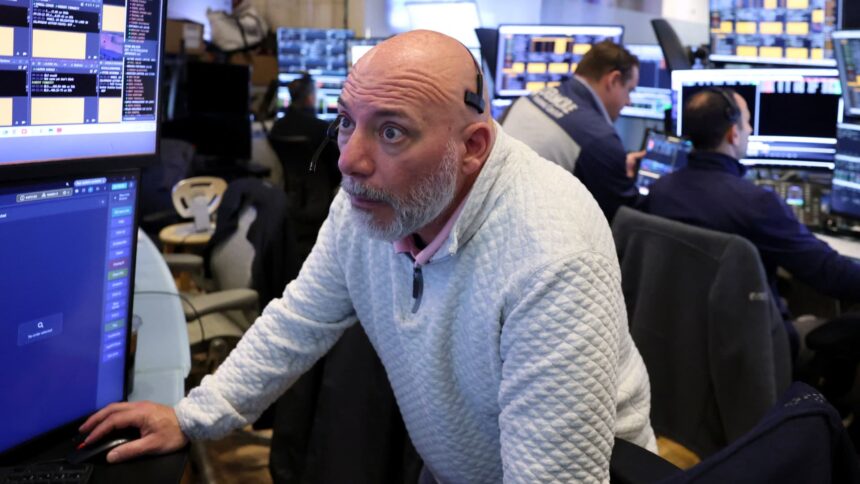
Every weekday, the CNBC Investing Club with Jim Cramer releases the Homestretch, providing an actionable update as trading on Wall Street reaches its final hour. On the last trading day of April, the markets saw significant gains, with the S&P 500 achieving an all-time intraday high, surpassing the 7,200 mark for the first time. The Nasdaq also experienced a rally, remaining just below its record set earlier in the week. Both indices are poised for their most impressive monthly performance since 2020, with the S&P 500 climbing over 10% and the Nasdaq rising over 15% for April.
Contributing to the market’s upward momentum were lower oil prices and bond yields. Brent crude dipped from wartime highs of $126 per barrel, while the 10-year Treasury yield decreased amid slower-than-expected U.S. economic growth.
A notable catalyst for the market’s performance on Thursday was the simultaneous earnings release from the four major hyperscalers: Alphabet, Amazon, Microsoft, and Meta. This is a rarity, as it provided an immediate perspective on their projected capital expenditures in the increasingly competitive landscape of artificial intelligence. Collectively, these tech giants announced they would spend at least $695 billion this year, a significant increase from a previous estimate of $608 billion—an over 14% jump.
Details of their capital allocation are as follows:
- Alphabet: $180 billion to $190 billion, raised from a prior estimate of $175 billion to $185 billion.
- Amazon: Remains unchanged at $200 billion.
- Microsoft: Approximately $190 billion, based on analyst estimates since no prior total was provided.
- Meta Platforms: $125 billion to $145 billion, up from the previous range of $115 billion to $135 billion.
This strategic spending underscores a clear commitment from the companies, particularly as they aim to stay competitive in AI advancements. However, market reactions to their capital expenditure plans varied. While Alphabet’s stock surged nearly 10% in response to its announcements, signaling strong investor confidence, Meta’s shares fell nearly 8%, reflecting a more cautious outlook.
In addition to the hyperscalers, all eyes are on Apple, which is set to report its earnings after the market close. This will be the first earnings call since CEO Tim Cook announced his forthcoming retirement, with John Ternus slated to step in as the new CEO in September. Analysts are expected to inquire about the transition, alongside insights into Apple’s strategy regarding AI and hardware under Ternus’s leadership. With over two decades at Apple, Ternus faces the challenge of maintaining momentum but comes equipped with extensive experience in launching key products.
Key points of focus during Apple’s earnings call will likely include the status of device sales in China, reception of the new MacBook Neo, and growth in services revenue. Another critical area of discussion will be the impact of rising memory costs and whether the company anticipates needing to increase device prices to protect its profit margins.
Additionally, companies in the memory sector, such as SanDisk and Western Digital, are also releasing earnings reports on Thursday evening. Attention is on whether their results will substantiate recent stock rallies, which have been fueled by tightening supply and a rebound in AI-related demand for high-performance storage solutions. Other notable companies reporting include Amgen, Stryker, and Agnico Eagle Mines.
On Friday morning, the investing community will eagerly await results from Club name Linde, as well as Exxon Mobil, Chevron, and Aon, with expectations for Linde to benefit from the global helium shortage exacerbated by current geopolitical tensions.
As subscribers of the CNBC Investing Club, members are notified of trade alerts before any transactions are executed within Jim Cramer’s charitable trust portfolio. There is a careful waiting period of 45 minutes following a trade alert and a 72-hour window if a stock has been discussed on CNBC TV before executing any trades.
This framework aims to ensure sound decision-making for investors while reiterating that membership in the Investing Club does not create any fiduciary obligations or guarantee specific investment outcomes.