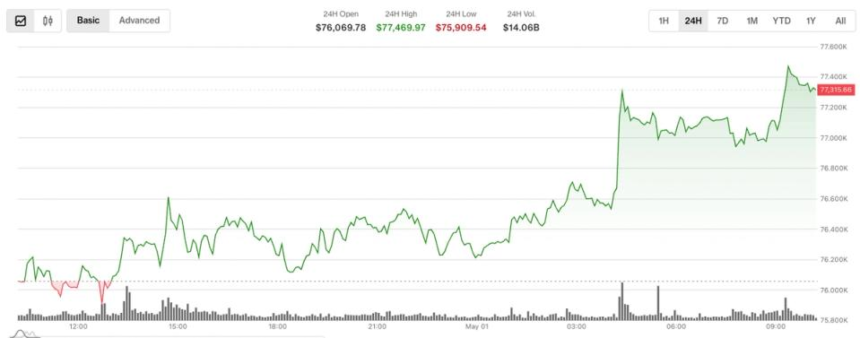
Bitcoin (BTC) has demonstrated a notable uptick, rising more than 1.2% during the European morning session and almost reaching $77,500. Over the past 24 hours, the cryptocurrency has seen an overall increase of approximately 1.7%. The broader digital asset market, as encapsulated by the CoinDesk 20 Index (CD20), has also experienced upward movement, climbing roughly 0.95%.
Encouragingly, Bitcoin’s gains have occurred alongside heightened trading activity, with trading volume recording levels 15% above the seven-day average. This surge in participation indicates a steady interest among investors, as highlighted by CoinDesk Research’s technical analysis data model.
However, the derivatives markets reflect a more cautious sentiment among traders. There has been a significant 22.5% rise in open interest for the June 26 $76,000 put option, suggesting a growing demand for downside protection near Bitcoin’s current price level. This spike hints that institutional investors are likely taking defensive measures, potentially to lock in profits or brace for possible price declines.
Adding to the cautious outlook, data from analyst Ali Martinez reveals that more than $770 million worth of Bitcoin has been transferred to exchanges over the past week. Such movements are typically considered a preliminary step toward selling, indicating that there could be significant selling pressure on the horizon.
The tight correlation between Bitcoin and the CD20 is noteworthy, with only a 0.15% deviation observed. This suggests that macroeconomic factors, rather than specific catalysts in the cryptocurrency market, continue to influence Bitcoin’s price action. The CD20 index, which encompasses a substantial portion of the digital asset market, reinforces the notion that Bitcoin is part of a broader risk complex rather than functioning independently.
As traders navigate this landscape, critical technical levels have been identified at $76,200 and $77,000. These markers serve as points of balance between the constructive price trends observed and the defensive positioning prevalent in derivatives markets.