Spirit Airlines is on the brink of shutting down after a turbulent final day of operations, with last-minute travelers such as Jeremiah Burton preparing for their first flights amid an emotional chapter for the airline. The 45-year-old air conditioning technician was set to depart from Baltimore/Washington International Thurgood Marshall Airport to New Orleans to visit his daughter and newborn twins, having booked a roughly $500 round-trip ticket.
By late Friday afternoon, Spirit Airlines was finalizing preparations for an overnight closure after more than 30 years of service. The airline had canceled international flights to prevent leaving travelers, planes, and crews stranded, having flown over 50,000 passengers just the previous day. The abrupt cessation of operations followed the rejection of an emergency $500 million bailout proposal from the federal government, which was aimed at offering critical assistance to the struggling airline.
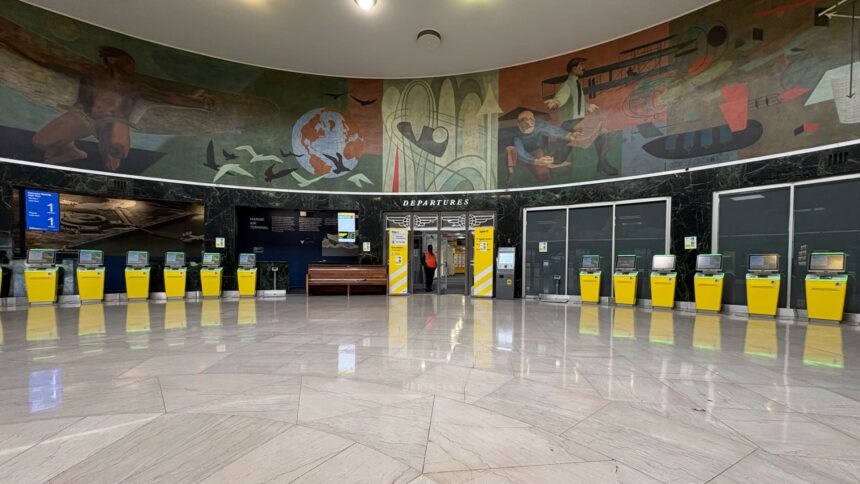
Early Saturday morning, Spirit’s website and mobile app displayed a definitive message: “all flights have been cancelled, and customer service is no longer available.” As the day progressed, LaGuardia’s Marine Air Terminal fell silent, marking a poignant end to Spirit’s operations in New York.
Several major U.S. airlines, including United and JetBlue, stepped in to assist stranded passengers by either capping fares or expanding schedules to accommodate those in need of travel. United Airlines reported that approximately 14,000 former Spirit customers booked flights with them on Saturday alone.
Amid the gloom of the airline’s decline, stories of dedication surfaced. Jon Jackson, a Spirit captain who was set to retire on the very day of the airline’s closure, found himself flying home on a Southwest Airlines flight. His fellow crew members organized a water cannon salute to celebrate his career, demonstrating solidarity in the face of uncertainty.
The challenges leading to Spirit’s collapse had been years in the making, beginning with its profitability during the 2010s and rapid expansion that ultimately turned unsustainable. Increasing competition from larger airlines, a failed merger with JetBlue Airways, and spiraling operational costs worsened their financial woes. The surge in fuel prices attributed to geopolitical tensions served as the final blow, forcing Spirit to file for bankruptcy protection for the second time in under a year.
The fallout from Spirit’s closure is extensive, as roughly 17,000 employees, both direct and indirect, faced job losses. Labor leaders have called for immediate assistance for affected workers, emphasizing the importance of addressing employees’ financial stability during the transition.
Despite its tumultuous reputation and the occasional derision it received, including a reputation as “the airline America loved to hate,” Spirit Airlines had carved out a niche in the market. With around 4% market share in the U.S., the airline was known for its no-frills, budget flights, making air travel accessible to many.
As the clock struck 3 a.m. on Saturday, the lights dimmed on Spirit Airlines, signaling the end of an era. The final flight, carrying 175 passengers, made its last descent shortly before midnight. The air traffic control operation conveyed heartfelt wishes to the departing crew, while Spirit dispatchers shared messages of support as they officially ceased operations.
As passengers and former employees come to grips with this significant change in the aviation landscape, the legacy of Spirit Airlines, both beloved and reviled, will linger in the memories of travelers across the nation.