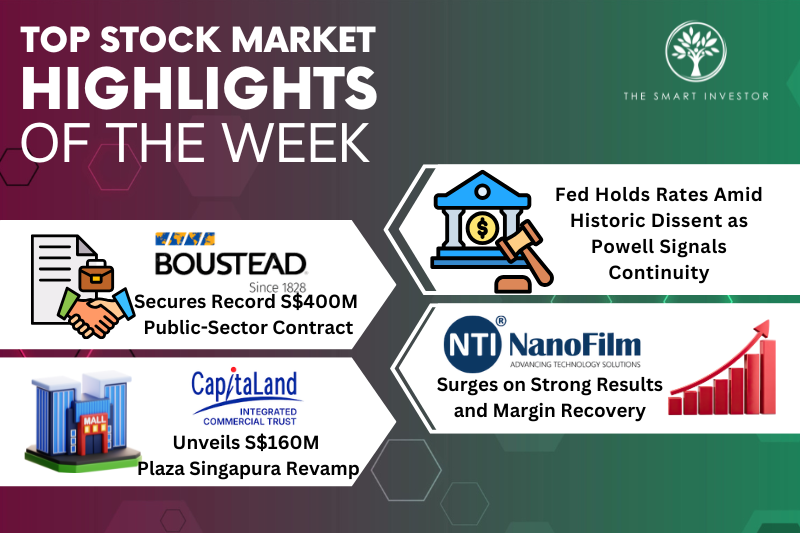
This week witnessed a dynamic shift in both geopolitical and economic landscapes, highlighted by significant developments in Washington and Singapore. Notably, the U.S. Federal Reserve opted to maintain interest rates amidst unprecedented internal dissent, marking the most substantial discord in over three decades. Meanwhile, Singapore’s Boustead clinched a record public-sector contract, while Nanofilm Technologies experienced a remarkable surge in share value.
In a closely-watched monetary policy meeting, the Federal Reserve decided to keep interest rates unchanged at 3.5% to 3.75%. However, the decision was overshadowed by a contentious 8-4 vote that highlighted divisions within the committee. Three officials expressed their opposition to indications of possible rate cuts, while a dissenting member, Stephen Miran, advocated for an immediate reduction of a quarter-point. The internal strife is unprecedented, marking the most significant dissent since 1992. Adding to the drama, Federal Reserve Chair Jerome Powell announced his intention to remain on the Board of Governors beyond May 15, complicating the transition for his anticipated successor, Kevin Warsh, whose nomination was advanced by the Senate Banking Committee.
Amid these monetary developments, rising tensions in the Middle East have heightened energy prices to a four-year high. This surge poses challenges in controlling inflation, potentially impacting economic growth—a critical concern for the Fed’s incoming leadership.
On the business front, Boustead Singapore secured its largest-ever contract, valued at S$400 million. Its engineering and construction division, Boustead Projects E&C, has been tasked with creating an office complex in Singapore. This notable win lifts the company’s real estate solutions division’s order backlog to S$837 million, while the broader engineering segment now exceeds S$1 billion. Boustead emphasized that the new contract is not anticipated to materially affect profitability or earnings per share for the fiscal year ending March 2027, yet it solidifies the company’s reputation as a leader in Singapore’s public-sector engineering and construction arena. Recent projects include Singapore’s pioneering multi-storey recycling facility, JTC Kranji Green.
In a noteworthy financial turnaround, shares of Nanofilm Technologies International surged 40.2%, closing at S$1.43 following the release of robust first-quarter results. The company reported a 24% year-on-year increase in revenue, reaching S$55 million, largely due to the performance of its advanced materials unit, which comprised 89% of total revenue. The consumer advanced materials segment saw a 32% rise, while industrial advanced materials increased by 9%. The improved revenue was accompanied by a significant recovery in profit margins, with gross profit margins expanding to 39%, up from 27% a year earlier. The company’s profitability outlook for FY2026 remains promising, buoyed by growth expectations across various segments, though it must navigate potential risks stemming from cyclical demand fluctuations and cost pressures.
Furthermore, CapitaLand Integrated Commercial Trust (CICT) announced a comprehensive S$160 million revamp of Plaza Singapura and The Atrium@Orchard. The renovation, set to begin in the third quarter of 2026 and concluding in the fourth quarter of 2028, aims to enhance the mall’s appeal on Orchard Road with upgraded infrastructure and a fresh tenant mix. As part of the Urban Redevelopment Authority’s initiative for further pedestrianization, the updated space will integrate greenery, offering improved dining experiences and innovative retail environments. The announcement follows CICT’s recent high-profile acquisition and sale transactions and aligns with the trust’s solid financial performance, showcasing a 7.9% year-on-year increase in net property income.
As external pressures continue to mount and local enterprises make strategic decisions to adapt and grow, stakeholders are closely monitoring the implications for the broader regional and global markets.