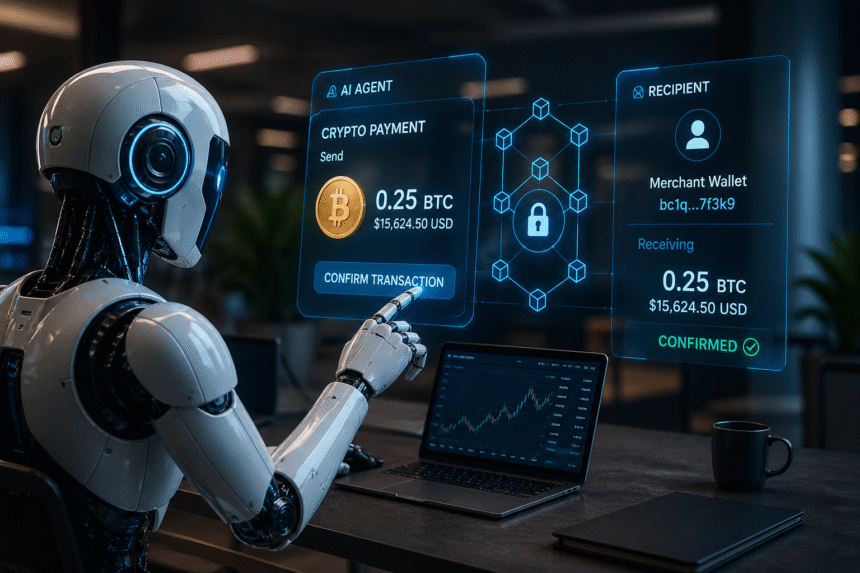
OKX has announced the launch of its Agent Payments Protocol (APP), an innovative open standard aimed at facilitating agent-led transactions within AI systems. This protocol is designed to enhance business activities by enabling AI agents to handle a wide range of commercial processes, including pricing, negotiation, escrow management, settlement, and dispute resolution.
In its announcement, OKX emphasized the shift in focus for AI agents from performing simple tasks to managing complex workflows and operations. The company noted that existing systems often do not support the full lifecycle of transactions, which has created a need for a more comprehensive solution.
Constructed as an open standard, the APP is intended to operate across multiple blockchain networks, with Solana and Ethereum being highlighted as key platforms for its initial deployment. The protocol includes a Payment Software Development Kit (SDK) that allows developers to seamlessly integrate various payment options—such as one-time, batch, and usage-based payments—using OKX’s X Layer infrastructure. This infrastructure is designed to facilitate transactions with minimal or even no gas costs.
Supporting the APP is OKX’s self-custodial Agentic Wallet. This wallet utilizes trusted execution environments and operates across a broad spectrum of over 20 blockchain networks, enabling AI agents to securely hold and transfer funds without relinquishing control. Communication between agents has been incorporated into the framework, which connects systems using standard internet protocols like HTTP and XMTP, along with support for popular messaging platforms such as Telegram. This integration aims to enhance coordination among autonomous systems during transactions.
Planned functionalities for the protocol include an escrow feature, which ensures that funds are only released when specific delivery conditions are met, as well as integrated dispute resolution mechanisms; however, these features are still under development.
The introduction of the APP comes amid a growing trend among companies striving to establish standards for AI-driven transactions. Recently, Coinbase launched its own x402 protocol to facilitate stablecoin payments between agents, expanding into a marketplace that allows AI systems to discover and obtain services without the need for API keys. Nick Prince, a product lead at Coinbase, highlighted the platform’s capacity to provide access to thousands of services without requiring human input.
Additionally, Visa has introduced a command-line tool through its crypto division, allowing AI systems to execute card payments during development workflows without the need for sensitive API credentials. Meanwhile, infrastructure backed by Stripe has advanced with the introduction of the Tempo blockchain and a Machine Payments Protocol aimed at supporting high-volume, programmable transactions across various payment rails.
OKX’s APP builds upon these developments by emphasizing end-to-end transaction execution, rather than merely facilitating standalone payments. The protocol has garnered support from numerous cloud and technology entities, including AWS and Alibaba Cloud, along with crypto firms such as Nansen, Uniswap, Paxos, and QuickNode. On the blockchain side, OKX has collaborated with networks including Base, the Ethereum Foundation, Solana, Sui, Aptos, and Optimism to enhance interoperability.
Star Xu, CEO of OKX, described the release as a crucial step toward realizing the Agent economy in practical settings. He noted that the protocol has been co-developed in collaboration with partners across various sectors, including cloud infrastructure, public chains, DeFi, and artificial intelligence.